
Your Running Toilet Is Costing You Money Every Single Day
You can hear it from the hallway. That faint, constant hiss of water running through the tank long after the last flush, sometimes all night, sometimes just long enough that you start to think it stopped, and then it starts again. You have jiggled the handle more times than you can count. It works for a day, and then the sound is back. A running toilet is one of the most consistent sources of wasted water in a home, losing anywhere from 20 to 200 gallons per day, depending on the severity of the internal leak, and most homeowners tolerate it for months or years because it does not feel like an emergency. The jiggle trick buys just enough relief to make the problem feel manageable. It is not. The internal components causing the run are wearing further every day, and what is a flapper or fill valve job today becomes a more involved repair when those parts fail.
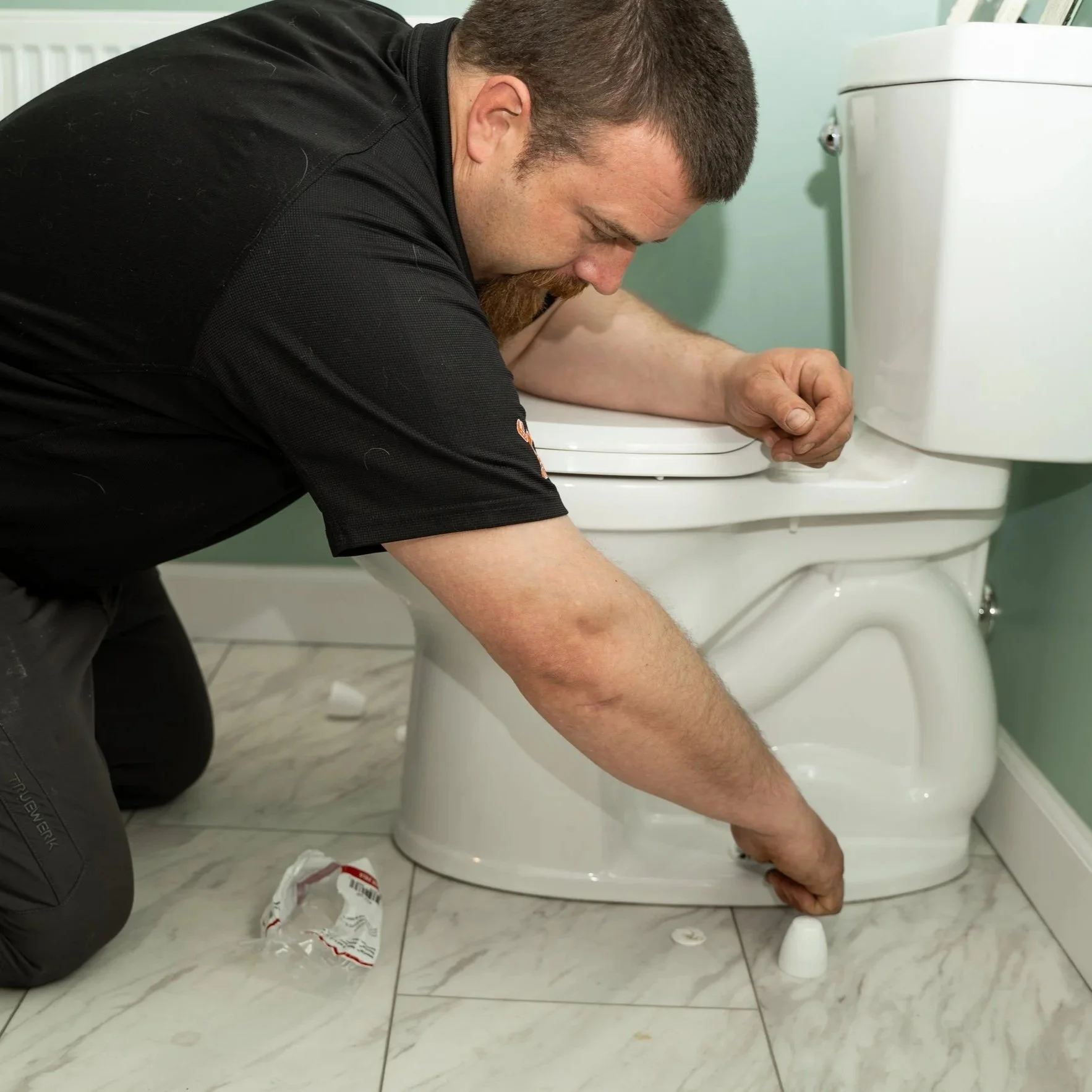
A professional plumber kneels to inspect the toilet base, checking the wax ring and floor flange to prevent sewer gas and water damage.
What Is Actually Going On Inside a Running Toilet
A toilet that runs continuously or intermittently after flushing has one of a small number of internal causes, and identifying the correct one is what determines which toilet repair is actually needed. The most common cause is a worn flapper, the rubber seal at the bottom of the tank that opens when the toilet is flushed and closes to allow the tank to refill. Flappers are made of rubber and degrade over time through contact with water, chlorine, and the minerals present in the supply. A flapper that has hardened, warped, or developed mineral deposits on its seating surface cannot form a complete seal, so water seeps continuously from the tank into the bowl. That seepage keeps the fill valve running to compensate, which produces the hiss homeowners hear.
The fill valve is the second most common source of toilet repair calls. A worn, improperly adjusted, or failing fill valve will either overfill the tank to the point where water runs continuously through the overflow tube, or it will fail to shut off completely at the correct water level, keeping the valve running in a partial-open state. Both conditions produce the same audible symptom, a running sound, but they have different causes and different fixes. A flapper replacement does not resolve a fill valve problem, which is one of the reasons homeowners who buy a replacement flapper and install it themselves still find the toilet continues to run. If the fill valve is the actual source, replacing only the flapper produces no improvement.
The Toilet Repair Mistake Most Homeowners Make
Hardware store toilet repair kits and individual components are widely available, and many homeowners attempt a flapper swap as the first response to a running toilet. In some cases, that fix is correct, and the problem resolves. In many others, it does not, because the flapper was not the root cause. What then happens is that the homeowner has spent time and materials on a repair that did not work, has put the toilet back together twice, and is still hearing the same hiss. The next attempt is often to replace the fill valve, again with a universal kit that is approximately correct but not specifically matched to the existing tank geometry. Universal replacement parts are designed to fit a range of tank configurations, approximately, not precisely, and imprecise fitting can result in a repair that is temporarily adequate but develops a new issue within a year.
The underlying mistake is diagnosing based on assumptions rather than on observation. A toilet that runs can be tested in a few minutes to determine whether the flapper or the fill valve is the source. Adding a few drops of food coloring to the tank and waiting ten minutes without flushing reveals a flapper leak if color appears in the bowl. Checking whether the water level in the tank is above the overflow tube indicates whether a fill valve adjustment or replacement is needed. That two-minute diagnostic determines which component actually needs attention and prevents the cycle of replacing the wrong part first. Professional toilet repair begins with that diagnosis and addresses the correct component the first time, which is why it tends to resolve the problem in a single visit rather than across multiple attempts.
When a Running Toilet Points to a Bigger Problem
Most running toilet situations are resolved by flapper or fill valve work. But some cases where the toilet runs intermittently, particularly those where the running starts and stops on its own without anyone using the toilet, indicate a problem that is more specific and occasionally more serious. Intermittent running that occurs every 20 to 40 minutes, often called ghost flushing, is a sign that water is slowly seeping from the tank into the bowl at a rate fast enough to eventually drop the tank water level to the point where the fill valve activates to refill. The cause is almost always a flapper that isn't sealing correctly, but the intermittent pattern can sometimes make homeowners think the toilet is doing something more complex.
Cracked toilet tanks are a less common but genuinely more serious cause of running water. A hairline crack in the tank, particularly one near the bottom where water pressure is highest, can allow water to seep out slowly enough that it evaporates or drains without leaving a visible puddle on the floor, while still causing the fill valve to run frequently to replace what is lost. If a toilet runs constantly despite a new flapper and a properly adjusted fill valve, the tank itself should be inspected for cracking. A tank crack cannot be repaired reliably and requires tank replacement, which in most cases means full toilet replacement since matching a replacement tank to an existing bowl is not always practical with older models.
Wax Ring and Floor Flange: The Toilet Repair Nobody Expects
A toilet that rocks when sat upon, that produces a slight movement at the base, or that has a persistent sewer odor in the bathroom despite no visible leak, has a problem below the toilet itself. The wax ring, the seal between the toilet horn and the floor flange, is the only barrier preventing sewer gas and wastewater from finding a path into the bathroom. A wax ring that has been disturbed by a rocking toilet, that was not properly sealed at installation, or that has degraded over decades of service, is no longer providing that barrier. Sewer gas entering a bathroom through a failed wax ring produces the odor homeowners typically attribute to a clogged drain, and it does not go away with any amount of cleaning because the source is not the drain surface. It is the space between the toilet and the flange below it.
Addressing a failed wax ring requires removing the toilet completely, inspecting the floor flange for damage or corrosion, replacing the wax ring or an appropriate alternative, and resetting the toilet correctly. In homes where the toilet has been rocking for an extended period, the floor flange may be cracked, or the subfloor around the flange may have sustained water damage from repeated micro-leaks at the seal. Those findings expand the scope of the toilet repair. Still, they are far better discovered and addressed proactively than during a bathroom renovation or a home sale inspection, when open issues affect the transaction.
Handle, Trip Lever, and Chain: The Small Parts That Cause Outsized Problems
A toilet that requires the handle to be held down to complete a flush, or one where the handle has become stiff or unresponsive, typically has a trip lever and chain condition that is easy to address but easy to ignore because the toilet still technically functions. The trip lever is the arm that connects the handle to the flapper chain. If the chain is too long, it can get caught under the flapper and prevent it from seating completely, producing a constant run. If the chain is too short, the flapper cannot open fully during a flush, producing an incomplete flush that requires a second or third activation to clear the bowl. Neither condition is difficult to correct, but both will persist indefinitely if left unaddressed.
Handle assemblies corrode and become stiff over time, particularly in bathrooms with high humidity or in homes with hard water that leaves mineral deposits on the handle mechanism. A handle that requires significant force to operate or that feels like it catches at a point in its travel has an internal corrosion or scale condition on the pivot. Replacing the handle assembly is a straightforward toilet repair that improves the daily use experience significantly and prevents the added wear that comes from applying excess force to a mechanism that is already degraded.
