
Why Won't My Sump Pump Shut Off? What Non-Stop Running Means
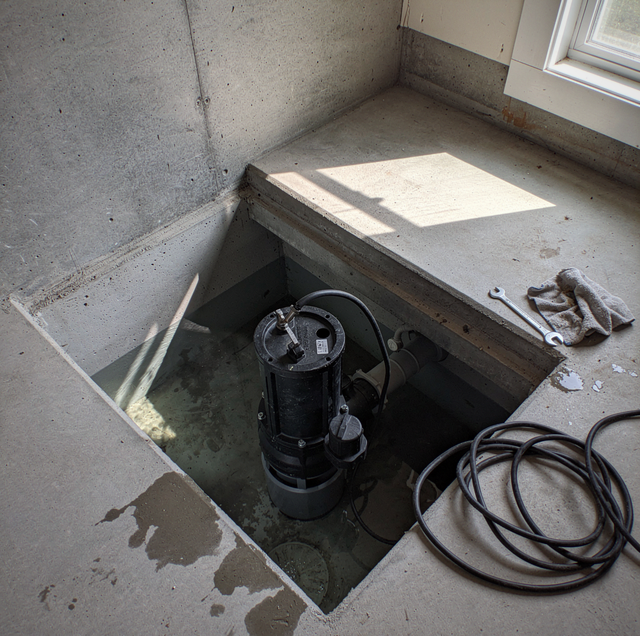
A sump pump that never rests is telling you something is wrong, even if the basement floor still looks dry. The whole system is built around a cycle: water rises, the pump kicks on, the water drops, the pump shuts off. When that off half of the cycle disappears, and the motor keeps grinding, you're looking at one of a handful of specific problems, and figuring out which one applies is mostly a matter of watching and listening for a few minutes.
This piece walks through how the normal cycle is supposed to work, the five most common reasons it breaks down into constant running, how to tell them apart without opening anything up, and when the smart move is to stop troubleshooting and call in help.
How A Sump Pump Is Supposed To Cycle
A basic sump system has three parts working together: a pit dug into the lowest point of the floor, a pump sitting in that pit, and a float switch that tells the pump when to turn on and off. Groundwater seeps into the pit through gravel and drainage tile around the foundation. As the level climbs, it lifts the float. Once the float reaches a set height, it trips the switch, the motor fires, and the pump pushes water out through a discharge pipe. As the pit empties, the float drops back down, the switch releases, and the motor shuts off until the water rises again.
That's the entire job: rise, trigger, drain, stop, repeat. During a heavy rain, the cycle might repeat every few minutes, which is normal and exactly what the system is designed to do. What's not normal is a motor that runs continuously without ever completing that drain-and-stop half of the loop.
Cause One: A Stuck Or Jammed Float Switch
The float switch is a simple mechanical part, and simple parts fail in simple ways. A tethered float can get caught on the pump housing, the discharge pipe, or the side of the pit, so it never falls back down even after the water level has dropped. A vertical or ball-style float can jam on a buildup of grit, rust, or sediment coating the shaft it rides on. Either way, the switch reads "water still high" long after the pit has actually drained, and the motor keeps running against nothing but air.
This is one of the easier problems to confirm visually. Lift the pump's cover or look into the pit while it's running. If the float is tilted at an odd angle, wedged against the pit wall, or tangled in its own cord, you've found the cause. Gently freeing the float and giving it clear room to rise and fall often resolves the issue immediately. However, a float that keeps jamming on the same obstruction usually indicates a pit that's too small for the pump-and-float combination installed in it.
Cause Two: A Pump That's Too Small For The Water Coming In
Every pump has a maximum flow rate, measured in gallons per hour it can move. If water entering the pit through soil and drainage tile arrives faster than the pump can push it back out, the pump runs at full capacity nonstop and still can't keep up with the incoming flow. The float never gets a chance to drop because the water level never really falls, or falls only slightly before rising again.
This shows up most during sustained wet stretches when the ground is already saturated, and every rain adds to groundwater already pressing against the foundation. A pump that handled ordinary rain events fine for years can suddenly look undersized once the soil around a property stays soaked for days at a stretch. Listen for the difference: a properly sized pump completes its job and goes quiet between cycles, while an undersized one hums along steadily, occasionally slowing but never fully stopping.
Cause Three: A Broken Or Missing Check Valve
The discharge line carries water up and out of the house, and a check valve sits in that line to keep the water moving in one direction only. Without a working check valve, water already pumped out falls back down the pipe into the pit the moment the motor shuts off. The float senses the returning water, rises again almost immediately, and triggers the pump right back on. The result looks like continuous running, but it's actually rapid, repeating short cycles rather than one long unbroken run.
The tell here is timing rather than sight. Stand near the pit and count how long the motor runs before it shuts off, then how long the quiet gap lasts before it fires again. A failed check valve produces a short run, a brief pause of just a few seconds, then another short run, over and over. That pattern is different from a stuck float, which keeps the motor running continuously with no pause, and from an undersized pump, which runs long and steady rather than in quick bursts.
Cause Four: A High Water Table Or Heavy Groundwater Seepage
Sometimes there's nothing wrong with the equipment at all. During a stretch of sustained rain, snowmelt, or a seasonally high water table, groundwater can press into the pit continuously rather than in the intermittent trickle the system expects. In that situation, frequent cycling, or even near-constant running for a day or two, is the pump doing exactly what it should against conditions it was designed to handle, just at the edge of its normal range.
The way to separate this from an equipment problem is to watch what happens as conditions change. If the pump slows its pace and starts completing full on-off cycles again once the weather dries out or the ground has a chance to drain, the system is working correctly and simply had a demanding stretch to get through. If the running doesn't ease up even after several dry days, something mechanical is keeping it going, and it's worth a closer look.
Cause Five: A Failing Pump Motor
A motor nearing the end of its life sometimes struggles to build enough force to clear the pit efficiently, so it runs longer per cycle even when the incoming water volume hasn't changed. Listen for changes in sound: a grinding note, a labored hum, a rattle that wasn't there before, or a motor that runs noticeably hotter than usual (you can feel this at the pump housing after a cycle, though give it time to cool before touching anything electrical). A motor working harder than it used to, on the same amount of water it's always handled, points to wear rather than one of the mechanical causes above.
This is the cause most likely to end in a full failure rather than a fixable symptom. A struggling motor that keeps running under strain is often close to burning out entirely, at which point the pump stops working altogether rather than merely running too much.
Sorting Out Which Cause Applies
A few minutes of observation usually narrows the list. Start by looking at the float itself while the pump runs: if it's visibly jammed or tilted against something, that's the cause and the fix is often immediate. If the float moves freely but the motor never stops, listen to the pattern. Continuous unbroken running that only slows during dry weather points toward an undersized pump or a truly high water table. Short bursts separated by brief pauses point toward a failed check valve letting water slide back into the pit. A motor that sounds different, runs hot, or seems to be working harder than it used to points toward a failing unit regardless of what the float and check valve are doing.
Write down roughly how long each run lasts and how long the gaps are between them. That pattern is exactly what a plumber will ask about first.
Why Ignoring It Costs More Than A Service Call
A motor that never gets a rest period is under continuous mechanical and thermal stress it wasn't built to handle. Most sump pumps are designed around intermittent duty, running for short bursts with cooling time in between, not continuous operation for hours or days on end. Extended running raises the motor's internal temperature well past its normal operating range, which accelerates wear on bearings and seals and shortens the life of the unit considerably.
There's also a cost that shows up before any failure does: a motor running continuously pulls power the whole time, adding up on an electric bill in a way a normally cycling pump never would. A pump running flat out and still losing ground to rising water may give out at the exact moment a heavy rain needs it most. What looks like a minor annoyance today is often an early warning of the outright failure that will flood a basement during the next storm.
When To Call A Plumber
Freeing a jammed float or confirming the system is just working through a wet stretch are reasonable things to check yourself. A few situations call for a professional rather than more troubleshooting: a check valve that needs replacing, since installing one correctly on a discharge line takes the right fittings and orientation to actually stop backflow; a motor that sounds labored, runs hot, or seems to be failing, since a pump that quits without warning during a storm is a far bigger problem than one that's merely noisy today; and any case where the pump runs continuously for more than a day without the pattern easing, even in ordinary weather, since that points to a wrong-sized pump or a system issue that needs a trained eye. A plumber can also confirm the pump is properly matched to the pit and the water volume it actually needs to handle, the kind of assessment that prevents the next round of nonstop running before it starts.
Frequently Asked Questions
Yes. During a heavy or sustained rain event, a properly sized pump may run for several minutes at a stretch and cycle frequently. What's not normal is running continuously for hours with no pause, or running hard for days after the weather has cleared and the ground has had time to drain.
Only briefly, and only to inspect it. Unplugging a pump that's actively needed to keep a pit from overflowing removes your only protection against flooding while you look at the float or listen to the motor. Check it quickly, then restore power, or shut it off only long enough to physically clear a jammed float.
That pattern usually points to a failed check valve on the discharge line. Water that's already been pumped out falls back into the pit as soon as the motor stops, the float senses the return, and the pump fires again almost immediately. It looks like nonstop running but is actually rapid, with short, repeating cycles.
It can help if the current pump is actually undersized for the water volume coming in, but a bigger pump alone won't fix a stuck float, a bad check valve, or a failing motor. Matching pump size to the actual water volume is worth doing alongside fixing any mechanical issues, rather than instead of them.
There's no single safe number, since it depends on the specific pump and how well it dissipates heat, but most units are built for intermittent use with rest periods between cycles rather than extended continuous operation. Hours of uninterrupted running are enough to accelerate wear on the motor, bearings, and seals well beyond what normal cycling would cause.
Treat it as an emergency. A pump that fails outright while water is still entering the pit means nothing is protecting the space below it. Avoid standing in or near any standing water near the pump or its cord, and get a plumber out as soon as possible to assess the pump and get a working unit back in place.
Schedule a Sump Pump Inspection — Get a professional check of your float switch, check valve, and pump sizing before non-stop running turns into a burned-out motor. AT Plumbing Services serves Scarborough, South Portland, Portland, and surrounding areas. Call (207) 707-3170.
