
What Is a P-Trap? The Small Bend That Guards Your Home
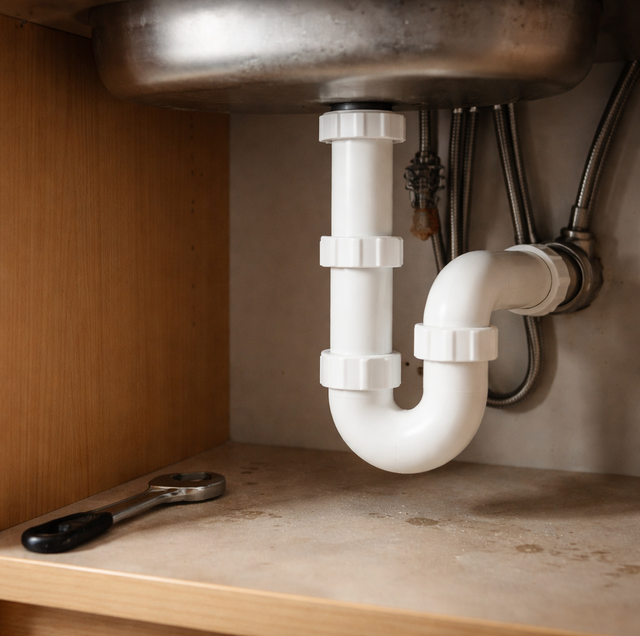
Quick Answer: A P-trap is the U-shaped bend of pipe under a drain that stays partly filled with water. That trapped water, called the trap seal, forms a barrier that stops sewer gas from coming up the drain while still letting waste and wastewater flow down. Every sink, tub, shower, and floor drain has one. If a trap dries out or is missing, sewer gas gets into the home.
Look under any bathroom or kitchen sink, and you will find a curved section of pipe shaped roughly like the letter P turned on its side. That curve is not a design accident or a way to route the pipe around something. It is a P-trap, and it does one specific job that the rest of your drain cannot do on its own: it holds a small amount of water in the bend at all times, and that water blocks sewer gas from rising back up the drain and into the room.
The Water Seal Is the Whole Point
Start with what the trapped water actually does, because everything else about a P-trap follows from it. When water drains from a sink, it flows down through the bend and out toward the sewer or septic line. But the shape of the bend means water never fully clears. A small plug of water stays behind in the low point of the curve after every use. That standing water is the trap seal, and it usually sits somewhere between two and four inches deep.
That buried sewer or septic line your drains connect to is full of decomposing waste, which produces gas as it breaks down. The gas rises. When it reaches the bottom of your trap, it hits the plug of water and stops, the same way an upside-down glass pressed into a filled sink keeps its pocket of air. The water is heavier than the gas and fills the width of the pipe, so nothing gaseous gets past it. Waste flowing down easily pushes through the seal on its way out, but gas trying to come back up cannot.
A trap works only as long as that seal holds. Break the seal, or let the water disappear, and the barrier opens. That single principle explains why traps exist, why they occasionally fail, and every check further down this page.
Where P-Traps Live in Your Home
Every plumbing fixture that drains into the sewer system has a trap. Under a bathroom or kitchen sink, the P-trap is easy to spot: it is the visible U-bend in the pipe below the drain, often chrome or white plastic, held together with rounded slip nuts. Pull open the cabinet, and it is right there.
Tubs and showers have traps too, though they hide below the floor or behind an access panel where you rarely see them. Toilets have a trap built directly into the porcelain, which is why the bowl always holds standing water even when nothing is running. Floor drains in a basement, garage, or laundry room have a trap set into the slab beneath the grate.
The rule with no exceptions: Any drain connected to the sewer needs a trap. A pipe that runs straight down to the sewer with no bend is an open channel for gas. Building practice treats a missing trap as a defect, not an option, which is why a legitimate fixture install always includes one.
Why a Dry Trap Lets Sewer Gas In
The trap seal depends on water staying in the bend, and water can leave the bend in a few ordinary ways. The most common is simple evaporation. A fixture you use every day gets its trap refilled constantly, so it never runs low. But a guest-bathroom sink, a spare shower, or a floor drain in a corner of the basement can sit unused long enough for the standing water to evaporate down to nothing. Once the bend is dry, that drain becomes an open pipe to the sewer, and gas walks right in.
A rarely-used floor drain is the classic offender. It might go months without a drop of water passing through it, and nobody thinks to check it because it is on the floor and out of sight. The first sign is often a faint sewer odor near it that comes and goes.
What the smell is telling you: Sewer gas is not only unpleasant, it can be hazardous. The mix contains methane, which is flammable, and hydrogen sulfide, which is toxic at higher concentrations and is the source of the rotten-egg smell. A dry trap is usually a harmless, one-minute fix. But a sewer smell that keeps returning after you have refilled the traps, or a trap that bubbles and gurgles, points to a venting problem that needs a plumber rather than another pour of water.
The Vent Keeps the Trap From Siphoning Itself Dry
Evaporation is the slow way a trap loses its seal. Siphoning is the fast way, and it explains a second pipe you may never have noticed.
When a large slug of water rushes down a drain, it can act like a siphon and pull the trap seal along with it, sucking the bend dry in a single cycle. To prevent this, your plumbing includes a vent system: pipes that run upward from the drains and exit through the roof. The vent lets air into the drain line behind the moving water, which breaks the suction before it can empty the trap. It also gives sewer gas a path to escape above the roof instead of pushing into the room.
Traps and vents are a matched pair. A properly vented trap holds its seal through normal use for years. A trap that is poorly vented or whose vent is blocked will gurgle, drain slowly, and lose its water, which is why persistent gurgling is a signal to bring in a professional rather than something to ignore.
S-Traps and Why They Get Replaced
Older homes sometimes have an S-trap instead of a P-trap. The names describe the shape: a P-trap bends down, curves back up, then runs horizontally to a vented drain, while an S-trap curves down and back up and then heads straight down again, forming an S.
The straight-down exit is the problem. With no horizontal run to a vent, an S-trap gives the draining water a clear vertical drop right after the bend, which generates exactly the siphoning action a vent is meant to prevent. The water pulls the trap seal down the pipe with it, leaving the bend dry and the barrier open. An S-trap that keeps losing its seal is the usual reason a plumber reworks it into a properly vented P-trap.
Common P-Trap Problems
The bend that makes a trap work is also the spot where things collect and fail. A few problems come up again and again.
Clogs in the bend: The low point of the curve catches whatever the water carries: hair, grease, soap scum, food particles, and the occasional dropped earring. Over time, this builds into a slow drain or a full blockage right at the bend. Because slip nuts hold the trap together, this is one of the few clogs a homeowner can reach by placing a bucket underneath, loosening the nuts, and clearing the trap by hand.
Leaks at the slip nuts: The rounded nuts that join the trap seal against a plastic or rubber washer inside. They can loosen over time or seat unevenly, and the result is a slow drip that shows up as a puddle or a water stain in the cabinet below. A gentle turn by hand often reseats them. Resist the urge to crank hard on a plastic nut, since overtightening cracks the plastic or crushes the washer and turns a small drip into a bigger leak.
A clog right in the bend is one of the few a homeowner can reach. Place a bucket underneath to catch the water, loosen the slip nuts by hand, then pull the trap and clear it out. When you reseat the nuts, turn them gently, since overtightening a plastic nut cracks it or crushes the washer.
A missing or bypassed trap: Occasionally a fixture ends up with no trap at all, usually after an amateur install or a renovation that skipped it, or with a flexible corrugated pipe standing in for a real trap. Either one lets gas through. A fixture that smells no matter how much water you run is worth a look underneath to confirm a real trap is actually there.
Simple Checks a Homeowner Can Do
Most trap trouble is diagnosable without tools. If a room has a faint sewer smell, walk to every fixture in it and run water for about thirty seconds at each sink, tub, and shower. For a floor drain, pour a couple of quarts of water down it. You are refilling any trap that has evaporated dry. Give it an hour and see whether the odor fades.
For a floor drain or other trap that truly sits unused for long stretches, pour in a small amount of mineral oil after refilling. The oil floats on the water and slows evaporation, stretching the time between refills. Under a sink, a quick look for moisture around the slip nuts tells you whether a leak is starting. What is worth handing off is anything that keeps coming back after the traps are refilled, along with any gurgling or bubbling, since those point past the trap itself to the vent system.
Frequently Asked Questions
A working trap holds a seal roughly two to four inches deep, measured from the top of the water down to the bottom of the seal. Plumbing standards set a minimum seal depth so the water column is heavy enough to resist being pushed out by gas pressure or pulled out by drainage. A seal much shallower than two inches is more likely to be siphoned or evaporated dry, which is one reason a homemade or improvised trap made from mismatched fittings often fails where a properly sized one holds.
Yes, if it sits in an unheated space such as an exposed line in a crawlspace, an unconditioned garage, or an exterior wall. Because the trap is the one spot that always holds standing water, it is the first part of a drain to freeze and can crack the fitting as the ice expands. A trap on an interior wall with regular use rarely freezes, but an unused fixture on an outside wall is the one to watch, which is a separate concern from the supply lines people usually worry about.
They do. A washing machine drains into a standpipe with a trap at its base, and that trap needs its own vent to keep the fast discharge from a machine from siphoning the seal. Floor drains carry a trap set into the slab, often with a small primer line that feeds it a trickle of water to keep the seal from evaporating in a drain that would otherwise sit dry for months.
Gurgling usually means air is being pulled through the trap seal because the vent is not supplying enough air, so the draining water borrows it through the nearest trap and disturbs the water as it goes. It is an early warning that the vent is partially blocked or undersized, and it often shows up before a trap actually loses its seal and starts letting odor through. It is worth investigating rather than tuning out.
Traps are commonly white PVC, black ABS, or thin-wall chrome-plated brass, and the material changes how you handle them. The thin decorative brass under an exposed sink corrodes from the inside over years and can develop a pinhole leak at the bottom of the bend, while PVC and ABS resist corrosion but crack if a slip nut is overtightened. Knowing which one is under your sink tells you whether a leak is likely corrosion or a stressed joint.
It is the trap that makes this risky. Because the bend holds standing water, a caustic drain cleaner poured in can pool against the fitting for a long time rather than flushing straight through, and repeated use can degrade a plastic trap or the washers at the slip nuts. Mechanical clearing, either removing the trap or running a small drain snake, is gentler on the fitting than leaving harsh chemicals sitting in the seal.
Smelling sewer gas or fighting a drain that will not clear — get the trap and vent checked by a pro who does it right the first time. AT Plumbing Services serves Portland, Scarborough, and South Portland. Call (207) 707-3170.
