
What Causes Low Water Pressure in an Old House? 7 Culprits
Quick Answer: Weak water pressure in an old house usually traces to a corroded galvanized supply pipe, mineral scale in fixtures, a failing pressure-reducing valve, or a shutoff valve that is not fully open. The first step is figuring out whether the problem is whole-house or a single fixture, because that split points to entirely different causes.
You turn on the shower in an older home and the spray never quite arrives, or you fill a pot and watch the stream trickle when it should gush. Low water pressure in an old house is rarely one dramatic failure. It is usually the slow result of decades of water moving through pipes, valves, and fittings that were never meant to run forever, and the fix depends entirely on which link in that chain has gone quiet.
Before you replace anything, it helps to understand where pressure comes from and where an old house tends to lose it. Pressure is the force pushing water toward your fixtures. Flow is how much actually arrives. You can have decent pressure at the street and still get weak flow at the tap because something between the two has narrowed, corroded, or been left half shut.
Start By Asking: Whole House Or One Fixture?
This single question narrows the search faster than anything else a plumber does, and you can answer it yourself in a few minutes. Walk the house and run the cold side at several fixtures: a bathroom sink, the kitchen, a tub, an outside hose bib.
If only one fixture is weak while everything else runs strong, the trouble is local to that fixture or the short run of pipe feeding it. If everything in the house is weak at once, the cause sits upstream, at the main supply, the meter, the pressure regulator, or a corroded trunk line that feeds the whole system. Sorting the problem into one of those two buckets keeps you from replacing a faucet when the real issue is a valve at the front of the house, or the reverse.
Corroded Galvanized Pipe: The Old-House Classic
Homes plumbed before the 1960s were commonly run in galvanized steel, and this is the single most common reason an entire old house loses pressure. Galvanized pipe is steel coated with zinc. Over decades, the zinc wears away and the exposed steel rusts from the inside, building up a rough, crusty layer of corrosion and mineral deposit that keeps thickening.
The problem is what that buildup does to the opening. A half-inch galvanized line can lose much of its inside diameter to scale, so that a pipe that looks fine on the outside carries a fraction of the water it once did. Rust flakes narrow the bore the way sediment silts up a stream until the channel is a trickle of its former self. Because the corrosion is worst at the threaded joints and horizontal runs where water sits, flow drops unevenly across the house, and the fixtures farthest from the main usually suffer first.
You can sometimes see the evidence: water that runs cloudy or rusty for a second when you first open a tap, or noticeably weaker hot-water flow, since hot lines scale faster. Replacing corroded galvanized with copper or PEX is a job for a plumber, because it means opening walls, cutting pipe, and re-running supply lines correctly.
Mineral Scale In Aerators And Cartridges
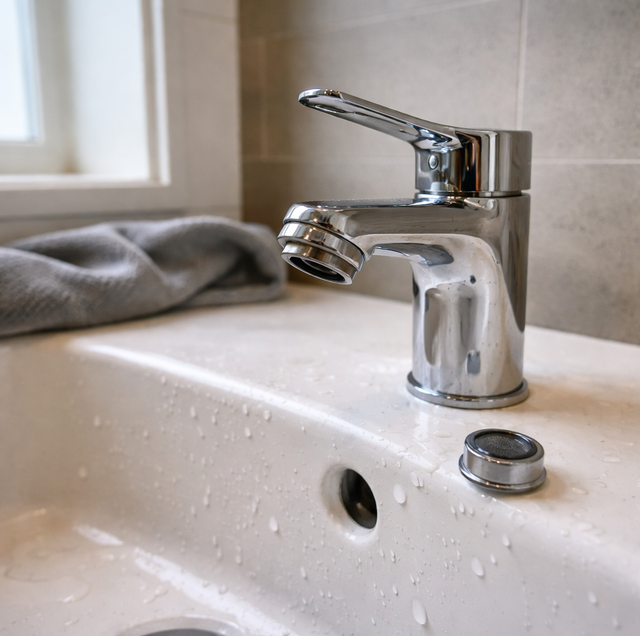
When only one or two fixtures run weak, the cause is often right at the fixture and easy to reach. The aerator, the small screened tip that threads onto the end of a faucet, catches grit, rust flakes, and mineral scale. In an older home shedding corrosion from upstream pipe, that screen clogs steadily until the stream weakens or sprays sideways.
This is the one repair a homeowner can safely handle. Unthread the aerator by hand or with tape-wrapped pliers, rinse out the debris, soak it in vinegar if it is crusted with white mineral scale, and thread it back on. Showerheads clog the same way and clear the same way.
The aerator is the one restriction a homeowner can safely clear. Unthread it by hand or with tape-wrapped pliers, rinse out the grit and rust flakes, soak it in vinegar if it is crusted with white mineral scale, then thread it back on. If the fixture is a single-handle faucet, the cartridge inside can also collect scale and restrict flow, though swapping a cartridge is a more involved repair.
A quick test to confirm it is the aerator: Remove the aerator entirely and run the tap. If flow jumps back to strong with the aerator off, the aerator or the screen behind it was the whole problem. If the tap is still weak with the aerator removed, the restriction is farther back in the supply line or a stop valve, and that points somewhere else.
The Pressure-Reducing Valve And What Goes Wrong
Many homes on municipal water have a pressure-reducing valve, sometimes called a pressure regulator, installed where the main line enters the house. Street pressure can run higher than household plumbing should see, and the regulator knocks it down to a safe range so fixtures and appliances are not hammered.
Like any valve with an internal spring and diaphragm, a regulator wears out. When it fails, it can drift the wrong way and choke pressure to the entire house, and it often does this gradually, so the decline is easy to miss until the shower feels feeble everywhere at once. A failing regulator is a leading suspect whenever whole-house pressure drops without any pipework having been done. Testing and replacing a regulator is pro work, because it sits on the main line and involves shutting down and re-pressurizing the whole system.
Valves Left Partly Closed
Sometimes the cause is almost embarrassingly simple. The main shutoff valve where water enters the house, or the meter valve, may not be fully open. After a repair, an inspection, or a winterization, a valve can be left cracked only partway, and that alone strangles flow to the entire house.
Older gate valves are the usual offenders. A gate valve raises and lowers an internal wedge, and over years the stem can corrode, or the wedge can partly seize, so a handle that feels open is really holding the gate halfway down. The same is true of the small stop valves under sinks and behind toilets, which can be bumped or left partly turned. Confirming that every shutoff is fully open, main and fixture stops alike, costs nothing and rules out an expensive diagnosis for a free fix.
Undersized Supply Lines And Shared Demand
Even with clean pipe and good valves, an old house can feel weak because of how it was plumbed. Older homes were often run with narrow supply lines sized for the modest fixture count of their era. Add a second bathroom, a dishwasher, and a modern rain-style showerhead, and the original pipe simply cannot feed everything at once.
That is why pressure sags the moment there is shared demand: the shower fades when someone starts the washing machine, or the kitchen weakens when an upstairs tap opens. The pipe delivers a fixed amount, and splitting it among several open fixtures drops the pressure at each. A branch line feeding a distant bathroom off a long, thin run will always feel softer than a fixture close to the main. Reworking undersized supply lines is a plumbing project, but recognizing the pattern tells you the pipe, not the fixture, is the limit.
Municipal supply versus a private well: The source matters too. On municipal water, pressure is set by the utility and delivered through the meter and regulator, so a whole-house drop usually points to the regulator, the meter valve, or the incoming line. On a private well, pressure is produced by a pump and stored in a pressure tank that cycles between a low cut-in and a high cut-out setting. A waterlogged tank, a failing pump, or a clogged well screen shows up as low or fluctuating pressure throughout the house, and those are diagnosed and serviced differently from a city connection.
How A Plumber Actually Diagnoses It
A good diagnosis is a process of elimination, not a guess. The starting point is usually a gauge test. A plumber threads a pressure gauge onto an outdoor hose bib or a laundry connection and reads the static pressure with everything off, then watches how far it falls when fixtures open. A low static reading points upstream to the regulator or the main. A reading that is fine at rest but collapses under demand points to a restriction or undersized pipe between the gauge and the fixtures.
From there, the work is isolating sections. By opening and closing valves and reading pressure at different points, a plumber can tell whether the loss is before or after the regulator, on the hot side or the cold, or confined to one branch. Comparing hot against cold is especially telling in an old house, because the hot line scales and corrodes faster, so a big gap between the two often finger-points the water heater feed or the galvanized on the hot side. Each test rules out a section until only the failing one is left, which is how a plumber replaces the right thing instead of guessing.
Frequently Asked Questions
Residential water pressure is generally considered healthy in the range of about 40 to 60 psi, and most plumbing codes cap it around 80 psi to protect fixtures and appliances. A plumber reads this with a gauge on a hose bib. If a static reading comes back under roughly 40 psi, the supply itself is weak, whereas a reading in the normal range that still gives poor flow points to a restriction inside the house rather than a pressure shortage.
Yes. Sediment settling in the bottom of a tank water heater can partly block the outlet, and corrosion at the hot-water nipples on top of the tank, especially older heat-trap nipples, can restrict flow to the hot side only. If cold runs strong everywhere but hot is weak throughout the house, the heater and its connections are prime suspects. This is pro work, because it involves the tank, the connections, and often the gas or heating side of the appliance.
It can. A leak on a pressurized supply line bleeds off water and pressure before it reaches your fixtures, so a sudden drop with no valve or pipe work done is worth investigating. A telltale sign is a water meter that keeps creeping when every fixture in the house is shut off, which means water is escaping somewhere between the meter and the taps. That is a reason to call rather than wait.
It can if it is neglected. A clogged sediment or carbon cartridge in a whole-house filter chokes flow to everything downstream, and the drop is gradual as the cartridge loads up, so it mimics failing pipe. Checking or changing the filter cartridge on the maker's schedule, often every few months, rules this out quickly. Some systems have a bypass so you can test pressure with the filter out of the loop.
Sometimes. Municipal pressure can dip during peak-use hours or if the utility is doing main work, and in a shared building the demand from other units on the same line can pull your pressure down at busy times. If weak flow tracks certain times of day and clears otherwise, the cause may sit outside your walls entirely, and a plumber's gauge test at different hours can confirm whether the incoming supply is the limiting factor.
Low flow is, and the distinction matters for the fix. True low pressure means the force at the main is weak, often a regulator or supply issue. Low flow means the force may be fine but something narrow, corroded scale, a clogged aerator, an undersized branch, is throttling how much water gets through. Old houses far more often suffer restricted flow through aged pipe than a genuine shortage of pressure, which is why replacing corroded lines fixes so many cases that a new regulator would not touch.
Book a pressure diagnosis and get a straight answer on what is choking your flow — a gauge test and section isolation find the real cause instead of guessing. AT Plumbing Services serves Scarborough, South Portland, Portland, and surrounding areas. Call (207) 707-3170.
