
Old Galvanized or Lead Water Pipes? When to Replace Them
You fill a glass first thing in the morning, and the water comes out faintly brown, then clears after a few seconds. The pressure in the upstairs shower has been fading for years, so slowly you stopped noticing. The house is old, the pipes are original, and a voice in the back of your head keeps asking whether the lines bringing water into your home are still safe to drink from. They might not be.
Two kinds of old supply pipe drive that question: galvanized steel and lead. They fail in different ways, but in an older home, they often hide behind the same symptoms, and both are reasons to take a hard look at what's feeding your faucets.
What Galvanized Pipe Does as It Ages
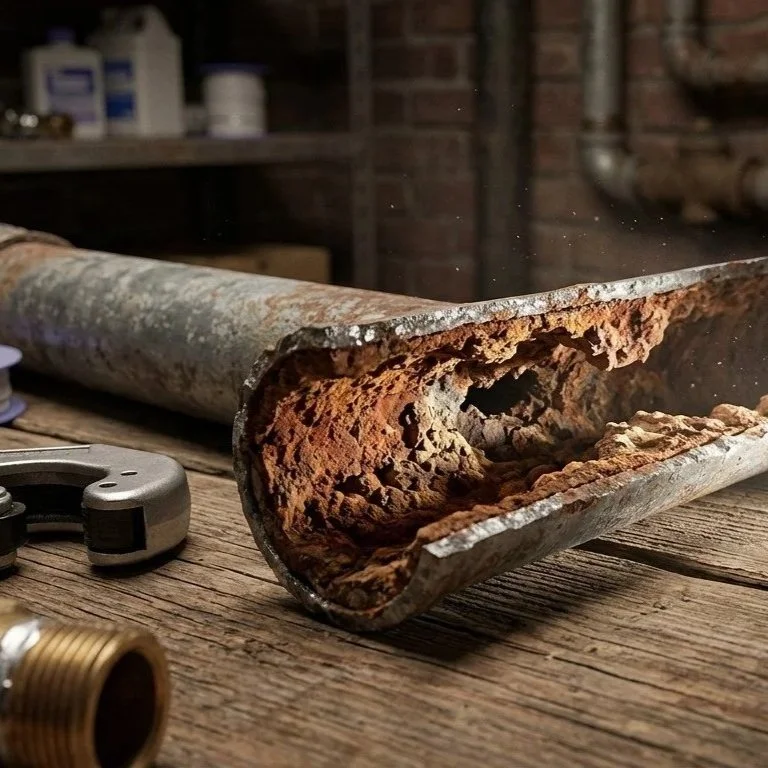
Galvanized pipe is steel coated in a layer of zinc to fight rust. For a few decades, it has worked. Then the zinc wears away from the inside, the bare steel underneath meets water, and it starts to corrode. The rust doesn't just thin the wall; it builds inward. Scale and rust deposits grow on the pipe's interior like plaque in an artery, and the opening through which the water flows shrinks year after year.
That's why the pressure fades so gradually; you adapt to it. A half-inch galvanized line can choke down to a pencil-width channel over 50 or 60 years. The brown tint in the morning is the rust shedding into the standing water overnight. And because the corrosion is heaviest where pipes join, the weak spots tend to be at threaded fittings, where a pinhole leak can open without warning inside a wall.
Here's the part that catches people off guard: replacing just the visible bad section rarely fixes it. The whole run is corroding at a similar rate, so swapping one elbow buys a little time before the next stretch fails. With galvanized, the honest answer is usually that the system is at the end of its life, not just one piece of it.
What Makes Lead Different, and More Urgent
Lead pipe is a separate problem, and a more serious one. Some older homes still have a lead service line (the pipe carrying water from the street main into the house), or lead solder joining copper lines, or brass fittings that contain lead. The issue isn't flow. It's that lead can leach into the water itself, and there's no level of lead in drinking water considered safe, especially for kids and pregnant women.
Lead doesn't leach at a steady rate. Water that sits in the pipe overnight or while you're away picks up more of it, which is why the first draw of the morning is the worst. Hot water pulls more lead than cold. And disturbing an old lead line, even nearby construction, can knock loose deposits and spike the level temporarily. You can't see it, smell it, or taste it, which is exactly why it's worth identifying rather than assuming you're fine.
| What you notice | What it points to | How urgent it is |
|---|---|---|
| Brown or rusty water that clears after a few seconds | Corroding galvanized pipe shedding rust | Plan replacement; it won't reverse |
| Pressure that's faded over years, worse upstairs | Galvanized lines narrowing from internal scale | Assess the whole system, not one spot |
| Repeated pinhole leaks at fittings | Galvanized failing at the threaded joints | Re-pipe the affected runs soon |
| Dull gray pipe you can scratch to a shiny silver, no threads | Possible lead service line or lead pipe | Test the water; treat as a priority |
| Old home, never had the water tested | Unknown: could be galvanized, lead, or both | Get it identified before deciding |
How to Tell Which One You Have
You can do a rough check yourself. Find the pipe where the water enters the house, usually near the meter or where the line comes through the basement wall. Galvanized steel is a dull silver-gray, threaded at the fittings, and a magnet sticks to it. Lead is a softer, duller gray with no threads; scratch it gently with a coin, and it turns shiny silver underneath, and a magnet won't stick. Copper is unmistakably copper-colored.
That's a starting point, not a verdict. The pipe you can see at the meter might be copper, while a lead service line still runs underground from the street, or a lead segment hides in a wall you can't reach. A water test tells you what's actually coming out of the tap, and a plumber tracing the lines tells you what's behind the walls. Together, they answer the question your morning glass of brown water raised.
So Should You Replace Them?
For galvanized, the case for full replacement gets strong once you're seeing rusty water, real pressure loss, or leaks at the fittings, because all three mean the corrosion is advanced and won't stop. Patching keeps you on a treadmill of repairs. A repipe in modern copper or PEX restores the flow you forgot you'd lost and ends the leak roulette.
For lead, the calculus is different. It's less about pressure and more about what you're drinking. Replacing a lead service line or lead-containing interior plumbing removes the source instead of managing it, and that's the durable fix. A filter certified for lead reduction can protect you in the meantime, but it's a stopgap; the real answer is getting the lead out of the path the water travels.
If your home predates the mid-1980s and you've never had the water tested or the supply lines identified, do that before you spend on anything cosmetic. A test plus a quick look at the incoming line tells you if you're dealing with worn galvanized, a lead concern, or both, and that decides what the repipe needs to cover.
Frequently Asked Questions
Yes. Galvanized corrosion is often worst as a slow pressure loss you've adapted to, with clear water most of the day and only a brown tint on the first morning draw. Lead is the bigger reason clear water can still be a problem: it leaches in without changing how the water looks, smells, or tastes. Clear water tells you nothing about lead, which is why a test matters.
Usually not. The entire galvanized system corrodes at roughly the same rate, so the stretch you replace today is followed by the next stretch failing tomorrow. Spot repairs make sense as a temporary measure to stop an active leak, but they don't solve a system that's reached the end of its service life. For a home with widespread symptoms, a full repipe is the move that actually ends the cycle.
Find where the main water line enters the house and check the pipe. Lead is dull gray, has no threaded fittings, scratches to a bright silver, and won't hold a magnet. If it matches that description, treat it as a priority and get the water tested. Keep in mind the visible pipe can differ from what's buried between the house and the street, so a plumber may need to trace it.
No. Boiling kills bacteria but does nothing about lead; if anything, boiling for a long time concentrates it slightly as water evaporates. The ways to reduce exposure are running the cold tap for a bit before drinking, after water has sat, using only cold water for cooking and drinking, and using a filter certified for lead. None of those replace removing the lead pipe, which is the real fix.
Most repipes today use copper or PEX. Copper is rigid, long-proven, and handles heat well. PEX is a flexible plastic line that's faster to route through finished walls, resists freeze damage better, and costs less to install in many homes. Both deliver clean, full-pressure water; the choice comes down to the home's layout, access, and your plumber's read on the job.
Less than you'd fear. An experienced crew routes new lines through basements, crawlspaces, attics, and existing chases, opening only the small access points needed to connect fixtures. There's patching afterward, but it's targeted, not a gut. In an older home, the plumber plans the runs to keep wall openings to a minimum while still reaching every fixture.
Don't Wait for the Brown Glass to Get Worse
Old galvanized pipe doesn't get better: it narrows, rusts, and eventually leaks, and patching one piece just moves the problem down the line. Old lead pipe is quieter and more serious, leaching into the water with nothing you can see. If your home is old enough to have either, the first step costs almost nothing: identify the lines and test the water. That tells you whether the trouble is a flow problem, a health problem, or both, and what a repipe needs to put right.
Worried your old pipes are rusting out or leaching lead — Get the supply lines identified, the water tested, and a clear repipe plan if you need one. AT Plumbing Services serves Scarborough, South Portland, Portland, and the surrounding areas. Call (207) 707-3170.
