
Maine Shower Valve Upgrades: What the Tile Is Hiding
The shower in the master bathroom has been on the list for a couple of years; the tile is dated, the valve trim looks like it belongs in a different decade, and the diverter has not worked correctly since last winter, when it started letting water run out of the tub spout during showers. The plan was to upgrade the trim and install a proper thermostatic valve system with a rain head. Then the plumber looked at what was behind the trim and found a rough-in valve from 1998 that predates the thermostatic system by a generation, a rough-in depth of four and a quarter inches that falls outside the new trim kit's adjustment range, and supply lines running through the exterior wall that go to three-quarter-inch copper for about two feet before reducing down to half-inch at the valve body. In Maine, that combination of conditions behind bathroom tile is not unusual. The housing stock is older, the original plumbing was installed to the standards of its era, and the conditions behind the tile have been quietly compounding ever since.
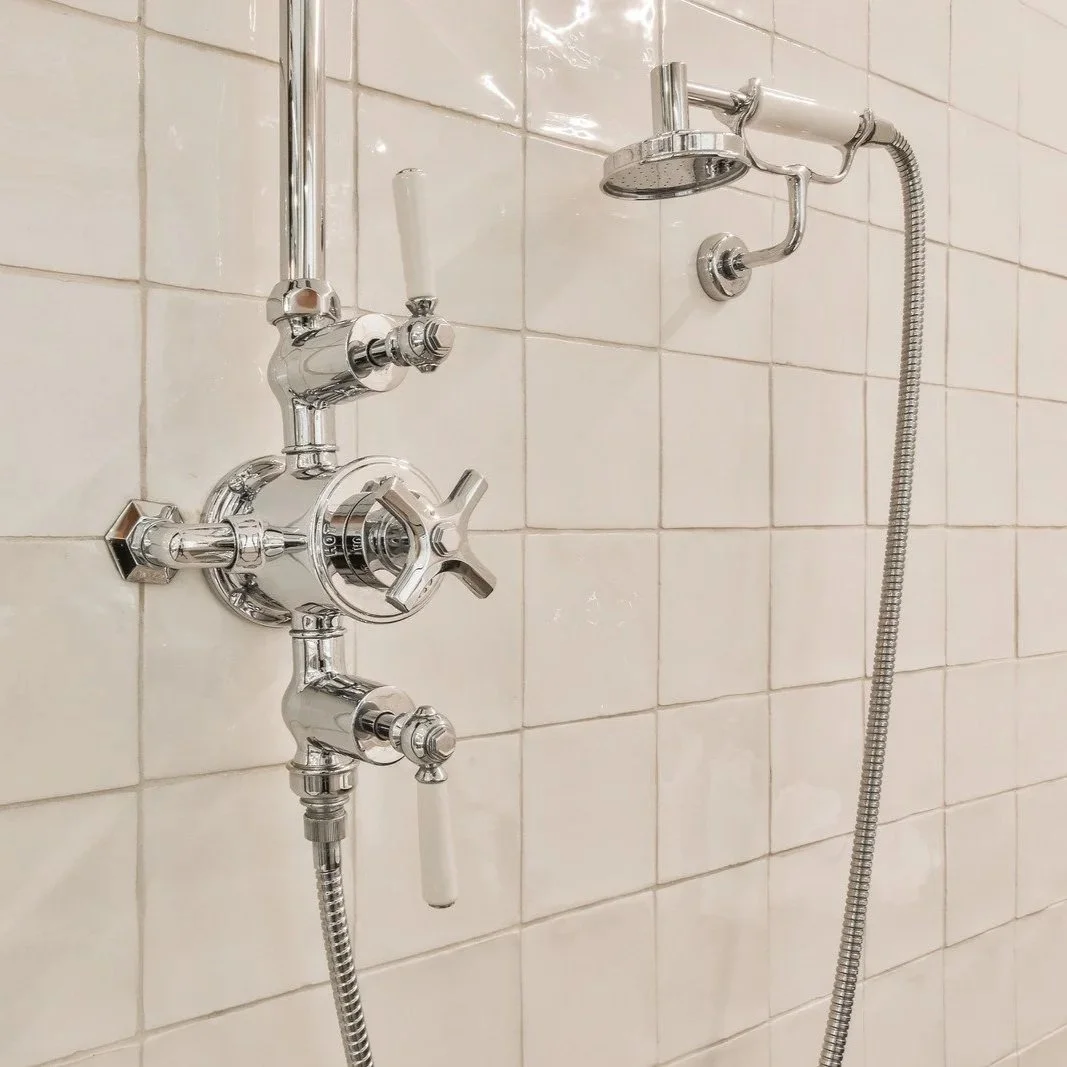
Modern shower valve upgrade with thermostatic controls, handheld shower connection, and chrome trim installation designed for reliable water pressure, cartridge performance, and long-term durability in older Maine bathroom remodels.
What Maine's Older Showers Have Behind the Tile
Maine homes with bathrooms that were tiled in the 1970s, 1980s, or 1990s have shower rough-in installations that reflect the product availability and installation practices of those decades. Pressure-balancing valves from that era were functional but are not compatible with modern thermostatic trim systems, are often at the end of their cartridge service life, and have supply configurations that assume a single-showerhead load rather than the multi-outlet systems typical of contemporary shower upgrades. The valve body material, the rough-in depth, and the supply connections are all period-specific and need to be assessed against the specifications of any new system being considered before anything is purchased.
In Maine communities throughout the Midcoast, the greater Bangor, ME, area, and the older neighborhoods of Portland, ME, the bathroom plumbing in homes from the mid-twentieth century was often done with galvanized steel supply lines that were later partially replaced with copper during kitchen or bathroom updates, leaving a system where the supply running to the shower valve is copper from the valve back to a transition point and galvanized from there to the main. A thermostatic shower upgrade on that supply system needs to account not only for the supply line diameter at the valve but for the effective flow capacity of the galvanized sections upstream, which may be partially occluded by decades of mineral scale and performing as a smaller-diameter pipe than the nominal size suggests.
Diverter Problems in Maine Tub and Shower Combinations
The tub and shower combination is the most common bathroom configuration in Maine's older single-family homes, and the diverter that redirects water between the tub fill and the showerhead is the component that most commonly prompts a shower upgrade conversation. A diverter that is losing its ability to seal the tub spout flow path completely, allowing water to split between the spout and the showerhead during a shower, is a well-known symptom in Maine homes with hard well water that deposits mineral scale on the diverter gate and seat surface over time.
The solution for a spout-mounted diverter that is no longer sealing correctly is replacing the tub spout, which is a contained project that does not require opening the wall. The solution for a valve-integrated diverter, which is part of the rough-in valve body, is either replacing the diverter cartridge within the existing valve body or replacing the entire rough-in valve if the existing body is no longer in service production and replacement cartridges are unavailable. In Maine homes where the tub and shower combination has an original rough-in from the late 1980s or earlier, the diverter cartridge for that specific valve may not be available from the manufacturer or from specialty suppliers, which means the diverter complaint triggers a full rough-in replacement rather than a targeted cartridge fix. At A.T Plumbing Services, the parts availability assessment for the existing rough-in is a step we complete before advising on the repair scope, because the answer changes whether the project is a spout swap, a cartridge replacement, or a wall-open rough-in replacement.
Maine Well Water and Shower Valve Cartridge Longevity
Maine homes on private well water with elevated mineral content or iron levels experience shower valve cartridge degradation on a shortened timeline compared to what the manufacturer specifies for average water conditions. A pressure-balancing cartridge rated for ten to fifteen years of service in standard water conditions may begin failing in five to eight years in a Maine home with notable well water hardness, because the mineral deposits that accumulate on the ceramic disc surfaces and the O-ring sealing surfaces prevent complete closure and smooth operation on an accelerated schedule.
A shower valve upgrade in a Maine home that replaces the rough-in valve without addressing the water quality is replacing the worn components with new ones that will wear at the same rate. Homeowners who have replaced shower cartridges multiple times in the same valve body, or who are upgrading a rough-in valve that was itself a replacement of an earlier valve, are observing a pattern that has a water quality cause. A plumber performing a shower valve upgrade in a Maine well-water home should discuss the water chemistry conditions and their effect on cartridge longevity as part of the upgrade consultation. In cases where the well water is notably hard or high in iron, recommending water treatment upstream of the shower supply as part of the project scope is a practical step that protects the new valve components from the same accelerated wear cycle.
Supply Line Sizing for Maine Shower Upgrades
The supply lines feeding a shower valve in a Maine home built before 1990 are often half-inch copper, which was the standard supply diameter for residential shower installations in that era. A single-head shower on a half-inch supply at typical residential pressure performs adequately, which is why the existing supply has not presented as a problem. A thermostatic shower upgrade that adds a rain head, body sprays, and a hand shower to a system that was previously a single-head supply creates a combined flow rate demand that a half-inch supply cannot serve adequately at the pressures typical in Maine homes on private well systems.
The pressure tank maintains the supply pressure in a Maine home on a private well and is typically set between 40 and 60 PSI at the tank, dropping further along the supply path from the tank to the shower valve. A four-outlet shower system on a half-inch supply line at 45 PSI at the valve body will produce noticeably reduced pressure at each individual outlet when all four are running simultaneously. Upsizing the supply line from half-inch to three-quarter-inch from the main supply branch to the thermostatic valve manifold requires running new pipe through the wall cavity, which is a wall-access project that should be planned as part of the rough-in replacement scope rather than discovered as a necessary addition after the wall is already open for the valve work.
Tile Access and the Maine Bathroom Wall Reality
Opening the wall in a Maine bathroom for a shower valve rough-in replacement requires removing tile, which in an older Maine bathroom means removing tile that is often no longer available in a matching product for patching. The ceramic tile patterns and colors common in Maine bathroom installations from the 1960s through the 1980s are no longer in production, and matching tile for a patch in a tile field of that era is typically difficult to impossible.
This reality has a practical implication for how a shower valve rough-in replacement in an older bathroom in Maine should be approached. If the tile cannot be matched for a patch, the access opening for the valve replacement either needs to be sized to be covered by the new trim plate, which requires careful coordination between the valve position and the trim plate dimensions, or the project scope needs to include retiling the affected area with a tile that is available and complementary rather than attempting to match original. A plumber and a tile installer working in coordination on a Maine bathroom shower valve upgrade can plan the wall opening and the trim layout together so that the result is intentional rather than a mismatched patch. That coordination conversation should happen before the wall is touched, not after the opening is cut.
