
Maine Laundry Supply Lines Fail When You're Not Watching
The washing machine in the upstairs hall closet has been running fine for years, and the rubber hoses behind it have been there since the laundry was moved upstairs during the 2009 renovation. You have not looked at those hoses since then. Fifteen-year-old rubber washing machine supply hoses under continuous water pressure in a second-floor laundry installation in a Maine home are not a question of whether they will fail. They are a question of when, and whether anyone will be home when they do. In Maine, that scenario carries particular weight because a significant number of Maine homes are seasonal or semi-seasonal properties where extended periods of vacancy are routine, and a hose that fails while the owners are away for two weeks in February has two weeks of run time before the damage is discovered.
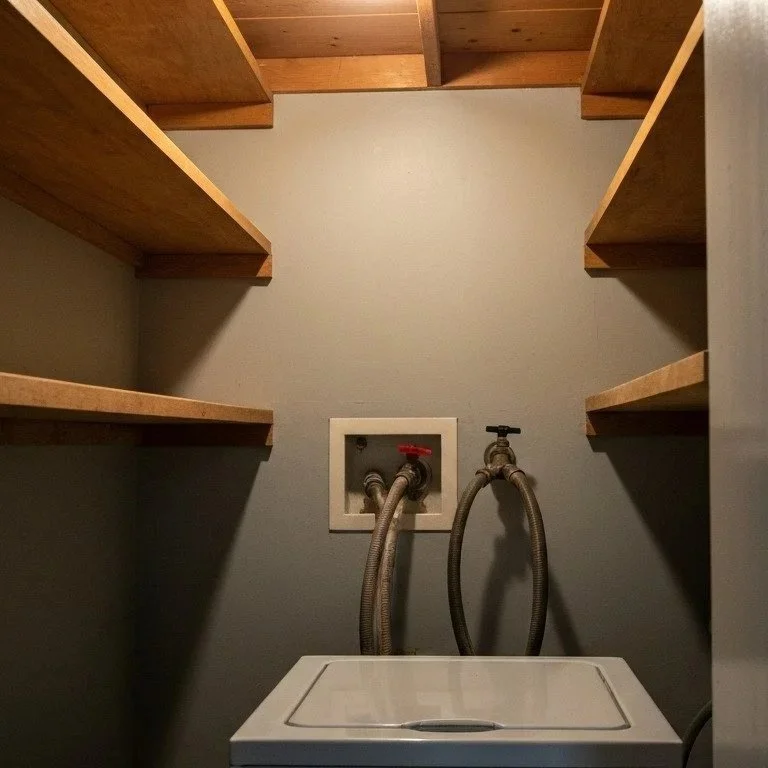
Aging laundry supply hoses in Maine homes can fail without warning, making braided stainless lines, reliable shutoff valves, and leak detection systems essential for preventing serious second-floor water damage.
Why Maine's Seasonal Properties Create the Highest Laundry Line Risk
A washing machine supply line that fails in an occupied home is typically discovered within minutes. Someone hears water, notices a wet floor, or sees the machine alarm, and the supply is shut off relatively quickly. The damage is real but contained. A supply line that fails at a Maine seasonal property or a home left unoccupied for several days is a different scenario entirely. The hose continues to flow at whatever rate the failure allows, undetected, for as long as the supply pressure holds and nobody arrives to shut it off. In a home with an automatic water shutoff device, the flow stops when the device detects the leak. In a home without one, the flow continues.
The laundry rooms in Maine's vacation properties and second homes frequently have washing machine installations that have not been serviced since the machine was placed. The supply hoses may be original equipment, may be the rubber hoses that shipped with the machine rather than upgraded braided stainless replacements, and may be connected to shutoff valves that have not been operated in years. That combination of aged hoses, seized valves, and vacancy periods is the profile that produces catastrophic laundry room water damage in Maine seasonal properties. At A.T Plumbing Services, spring startup inspections for Maine seasonal properties include the laundry room as a standard assessment point for exactly this reason.
What Hard Maine Well Water Does to Supply Line Fittings
In Maine homes on private wells, the water chemistry that accelerates wear on faucet cartridges and toilet fill valves also affects the metal fittings at the ends of washing machine supply hoses. The crimped brass fittings that connect the hose to the shutoff valve and to the machine inlet port are in continuous contact with the supply water, and in Maine homes with elevated mineral content or iron in the supply, those fittings develop mineral deposits on their seating surfaces and corrosion products on their exterior threads over time. A fitting that appears intact from the outside may have enough internal mineral accumulation at the gasket to create a seating irregularity that the rubber gasket inside the fitting cannot fully compensate for, producing a slow seep at the valve connection.
The visible sign of this condition, often an orange or rust-colored stain at the hose fitting on the valve body or at the machine inlet, is a diagnostic signal that Maine homeowners frequently notice and attribute to the machine or the valve rather than to the hose connection. Any sign of mineral staining or corrosion at a supply hose fitting in a Maine home is a reason to inspect the fitting closely and assess whether the hose and gasket need replacement. In a Maine home on iron-bearing well water, this inspection should happen annually rather than being deferred until the hose shows other signs of age.
Shutoff Valve Condition in Older Maine Laundry Installations
The shutoff valves behind washing machines in Maine homes, installed more than 20 years ago, are often old gate-style valves that have not been used since the machine was installed. Gate valves have a known failure mode: the gate mechanism inside the valve corrodes, and the stem becomes difficult to turn. In valves left in the open position for decades without operation, the gate may have corroded sufficiently to prevent full closure when the handle is turned. In a Maine laundry room, discovering that the shutoff valve will not close during an active supply line failure is one of the more stressful plumbing situations a homeowner can face.
Replacing old gate valves behind the washing machine with quarter-turn ball valves as part of a laundry water supply line installation is a step that adds very little cost to the project and provides a meaningful safety improvement. Ball valves operate reliably after years of disuse, close completely with a single quarter turn, and provide immediate visual confirmation of their open or closed state through the handle orientation. In a Maine home where the laundry room may be in a basement, a utility room adjacent to the garage, or an upstairs hallway closet with finished space below, having shutoff valves that actually close when needed is not a convenience. It is what determines whether a supply line failure is a manageable event or a significant water damage claim.
Second-Floor Laundry in Maine Homes: The Risk Profile That Demands Better Hardware
Second-floor laundry installations have become increasingly common in Maine home renovations as homeowners move laundry from basements to more convenient upper-floor locations. The convenience is real. The added risk profile is also real and deserves explicit acknowledgment in how the supply lines and shutoff valves are specified and installed. A laundry supply line failure on the second floor of a Maine home releases water into a floor assembly that sits directly above a finished living space, and in older Maine homes with board-sheathed subfloor construction, that water finds its way through the floor assembly and into the ceiling below faster than it would through a modern plywood subfloor.
Laundry water supply line installation for a second-floor laundry in a Maine home should include braided stainless steel supply hoses rather than rubber, quarter-turn ball valves at the wall connections rather than gate valves, and a water detection device with an automatic shutoff capability mounted at floor level in the laundry space. That combination provides a layered protection approach: the higher-quality hoses reduce the likelihood of hose failure, the accessible ball valves provide reliable manual shutoff, and the automatic detection device catches any leak before it can run undetected while the household is away. In a Maine home with a second-floor laundry above a finished master bedroom or living room, those three components together represent a modest investment compared to the cost of remediating water damage in finished upper-floor living space.
Winterizing Laundry Supply Lines in Maine Seasonal Properties
Maine seasonal properties that are closed for the winter require laundry supply line winterization as part of the full plumbing shutdown process. Washing machine supply valves need to be closed, the hoses need to be disconnected from the machine to allow complete drainage, and any supply lines in exterior wall cavities or unheated utility spaces need to be assessed for freeze exposure. A supply hose that is left connected to a closed valve in an unheated laundry room through a Maine winter may have residual water in the hose that freezes and cracks the fitting or the hose body.
The winterization sequence for a laundry room in a Maine seasonal property should include closing the supply valves, disconnecting and draining the hoses, disconnecting the machine drain hose, and running the machine through a short drain cycle to remove water from the pump and tub before the machine is left for the season. In laundry rooms in unheated or poorly heated spaces, the supply valves themselves may need additional protection, or the supply lines may need to be blown out with compressed air if the valve bodies are at risk of freezing at the mounting location. A plumber performing a full seasonal property winterization for a Maine home includes the laundry room in the scope as a standard step, rather than treating it as a fixture type that can be skipped.
