
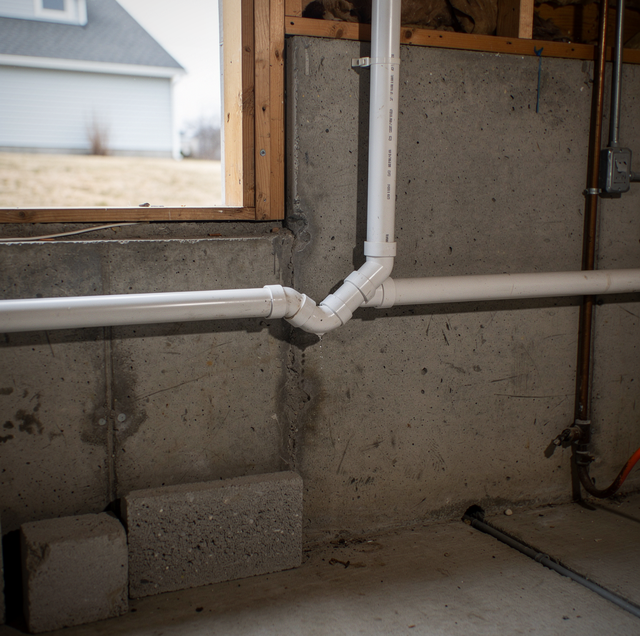
A sump pump's discharge line has one job once the motor kicks on: carry that batch of water up, out through the wall, and away from the foundation, then sit empty until the float calls for it again. Between cycles, there's supposed to be little or no water left in the pipe to freeze. When the ground and outdoor air drop below freezing, a line that isn't draining the way it should can hold a pocket of water long enough to turn to ice, and that ice plug can turn a quiet pump into one that runs constantly, backs up a pit it can't empty, or leaks somewhere it never has before. Each symptom pairs with the stretch of line where the ice is likely sitting:
| Symptom | Where the Blockage Is Likely Sitting |
|---|---|
| Pump runs, but the pit level does not drop | A sag or low point in a shallow or exposed stretch of the run |
| Pump runs continuously or trips its breaker | A full blockage somewhere along the line's length |
| Water showing up at a joint or around the pit | A blockage further down the line pushing water back against the nearest indoor fitting or the pit lid |
| A mound of ice building at the outlet | The outdoor end, right at the exit |
| Pump hums or strains, but nothing comes out | The outlet iced shut, or a jammed impeller or failing motor inside the pump |
Where Water Sits After Each Cycle
Once the pump pushes water through the check valve, that valve keeps the column above it from falling straight back into the pit between cycles; what happens next depends on the shape of the pipe beyond that point. A discharge line is supposed to run with a steady pitch away from the house so gravity finishes the job the pump started, draining the last few ounces out toward daylight instead of leaving them to sit. Where the ground has settled unevenly, where the line was strapped a little too high in one spot and too low in the next, or where a long horizontal run carries even a small dip, that low point becomes a reservoir. It holds a puddle after every cycle, whether the weather is warm or not. In summer that puddle just sits there and evaporates. Once outdoor and ground temperatures drop below freezing, the same puddle is what turns solid. It starts narrowing the pipe from the inside, cycle after cycle, until it closes off completely.
The Outdoor End
The stretch exposed to outdoor air is the last few feet, where the line rises above the ground or off the foundation wall and opens to the air. A run buried below the frost line stays insulated by the surrounding soil and doesn't get cold enough to freeze on its own; it's the shallow or above-grade section, and any hose or flexible extension laid flat on the ground past it, that sees the full swing of outdoor temperature. Snow piling against the outlet, or an extension line pooling water in its own low spots before it ever reaches open ground, gives that exposed stretch the same standing-water problem as an internal sag, except now it's sitting in the coldest air on the whole run. Once ice seals that opening, everything upstream of it has nowhere left to go.
What a Blocked Line Does to the Pump and the Pit
A pump that fires against a line with nowhere for the water to go doesn't know the difference between a closed valve and a wall of ice; it just keeps drawing power and trying to move water that has nowhere to be moved. The impeller keeps spinning but moves nothing, so the water trapped in the housing churns and warms, and a motor built to work in short bursts runs without a break. Meanwhile, the water it can't discharge stays exactly where it started, so the float never gets the drop it's waiting for, and the pump keeps running. If the pit is also taking on groundwater, the level climbs with nowhere for the pump to send it.
A sump pit holds water inches from a plugged-in motor and its cord, so a wet floor around the pit can carry current to anyone standing in it. A plumber cuts power from a dry spot before touching the pump.
A sump pit holds water inches from a plugged-in motor and its cord, so a wet floor around the pit can carry current to anyone standing in it. A plumber cuts power from a dry spot before touching the pump.
A pump running against a frozen line like this calls for a plumber, not a reset. If the switch or the breaker can be reached from dry footing, it's fine to shut the pump off there; if the floor around the pit is already wet, leave it alone and call instead of stepping into standing water to reach it.
Leaks That Show Up Indoors When the Line Is Blocked
Ice expands as it forms, and rigid pipe has nowhere to give. Couplings, fittings, and glued or threaded joints give before a straight length of pipe does. Expanding ice against those joints can crack a fitting or loosen a joint, and the damage shows itself once the ice inside starts to thaw and the trapped water finally has somewhere to go: down through the joint and onto the floor, the wall behind it, or the ceiling of whatever's below. A blocked line that's been backing water up toward the pump for a while can also push water out at the pit lid or the seal around the pump itself, which looks like a pit overflow but is the same root cause working from the other end of the line.
How a Plumber Corrects the Run
Fixing a line that keeps freezing means changing the path the water takes, or keeping its exposed stretch from freezing, not just thawing today's ice and waiting for the next cold snap to do it again. Re-pitching a sagging section so the whole run drains continuously toward the outlet removes the standing water a low spot depends on. Where the exposed or above-grade stretch is the problem, shortening it, rerouting it to cover less distance in open air, or burying more of it below the frost line removes the coldest part of the run. Some installations also add a small relief opening right where the discharge line exits the house, positioned above grade, so that if the tip of the line ever does ice over, the water backing up behind it has somewhere to escape before it works its way all the way back to the pump instead of building pressure against a dead end. Which combination makes sense depends on how the existing line was routed and how much of it a plumber can reasonably access without digging up the whole yard.
What You Can Check from Outside
Before calling anyone, a walk outside to check the discharge line's exit point is worth taking and doesn't require going anywhere near the pump. Check whether the opening is buried under snow, sitting in a drift, or capped by a mound of ice built up from earlier cycles freezing at the same spot; clearing that away can restore flow without any further work.
An outlet that ends flush with the ground or inside a drift refreezes at the same spot cycle after cycle. Raising the outlet or moving it clear of where snow piles is part of correcting the run.
What that outdoor check should never include is a torch, a heat gun, or any open flame held against the pipe to melt what's inside; PVC and the fittings around it aren't rated for that kind of direct heat, and a scorched or softened pipe is a worse problem than the ice was. The same goes for the indoor end: cutting or disconnecting the discharge line inside the house to let the pit drain onto the floor instead trades a frozen pipe for a wet basement and doesn't fix anything. If the outdoor end looks clear and the pump is still running without relief, the blockage sits further back in the run, or the pump has a problem of its own, and either way the visual check stops there.
Frequently Asked Questions
Yes. A stretch buried deep enough in the soil stays above freezing, so the basement's own temperature has little to do with where ice forms. The part at risk is the short, shallow, or above-grade stretch near the outlet, and if that segment was ever fitted with heat tape, a failed or unplugged heat tape section will freeze just like bare pipe would, even though the rest of the buried line stays fine.
Both leave the pit unemptied, but the pump behaves differently in each case. Against a full ice blockage, it runs without pause, and on pumps that have one, the thermal overload finally shuts it off. A failing check valve is a separate problem, with the pump cycling rapidly rather than running continuously against a dead stop.
Insulation slows the rate at which heat is lost from the pipe, but it doesn't add any heat of its own. A section with a low spot that holds standing water will still eventually freeze under insulation if the cold snap lasts long enough. Correcting the pitch or rerouting the exposed stretch is what solves it; wrapping the pipe alone does not.
That trades one problem for another. With the line disconnected, every pumped cycle discharges right next to the foundation instead of a safe distance away, and that water can refreeze against the wall or the footing it was meant to be routed away from. A line that's properly pitched and protected does the job without needing to be taken apart each time temperatures drop.
No, not when the pit is installed to normal depth in a heated basement. The pit and the pump sitting in it are set below the frost line, and heat moving in from the surrounding ground and the basement above keeps that water from freezing even during a hard cold stretch. The freeze risk stays confined to the discharge line's shallow or above-grade stretch, not the pump or the pit itself.
Yes. Once the pump cycles on next, watch the outlet instead of just listening for it to shut off. A full, steady stream at the outlet means the line is open all the way through; a trickle or dribble while the pump is clearly running means the flow is still being choked, either by a narrow ice channel left in the run or by a pump that has lost strength. A pump that turns on and off right on schedule can still be pushing water through that partly iced passage, and a surviving channel can close off again at the next freeze as temperatures drop.
Arrange sump pump service to correct the discharge line — the work re-pitches a sagging run, shortens or reroutes an exposed outlet stretch, and checks a pump that has been running against ice. AT Plumbing Services serves Scarborough, South Portland, Portland, and surrounding areas. Call (207) 707-3170.