
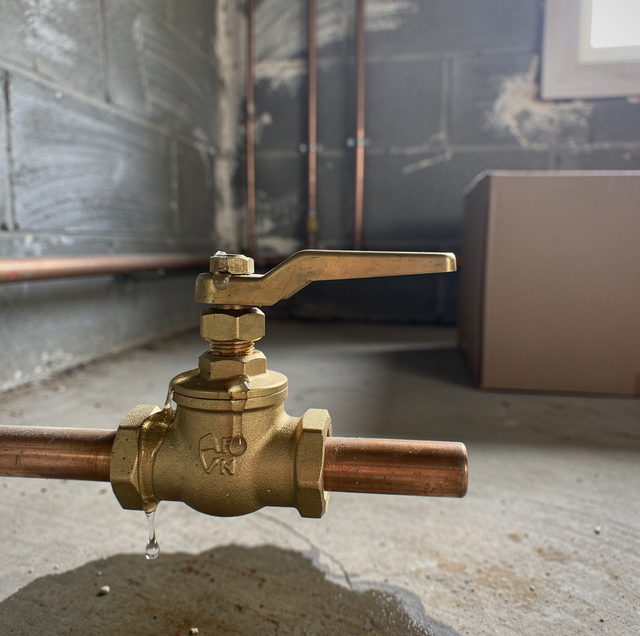
A house that's been shut up for weeks or months can pass every visual check with nothing wrong to see, then start leaking soon after the water comes back on. A crack in a fitting, a seal that's dried and shrunk, or a joint that's worked loose doesn't leak while the system sits empty or unpressurized, because there's no water pushing against it to escape through. The moment the main valve opens, and pressure fills the pipes again, every weak point in the system gets tested at once, and the ones that can't hold let go.
Each place water returns to is set against why it fails after a shutdown and how it shows first:
| Where | Why It Leaks After a Shutdown | How It Shows |
|---|---|---|
| Main shutoff valve and its packing | The packing around the stem can loosen after sitting untouched for a long stretch, or the valve develops a weep once it's worked open and closed again | A drip or slow weep at the valve stem once the main is fully open |
| A fitting or pipe that held water through a freeze | Ice expanding inside a closed section can split the pipe wall or force a joint apart, and the crack stays hidden until pressure returns | A spray or a steady stream right at the split, at a low point or an exterior wall |
| Compression and threaded joints | A joint that seals fine at rest can separate slightly under the surge that comes with full pressure, whether it was left short of full tightness or has loosened | A slow drip building at the fitting |
| Faucet and valve washers or cartridges | Rubber and other soft parts dry out and stiffen when nothing runs through them for months, so a seal that used to hold tight lets water past it | A drip from the spout, or a leak at the base of the handle once the fixture sees use |
| Toilet fill valves and supply connectors | The internal seal can stick or shrink without use, and a supply line's connection can back off slightly if it was disturbed while the house sat closed | Water running into the bowl that won't stop, or a puddle forming at the base of the tank |
| Water heater fittings and the relief valve | Fittings on a tank that sat idle see the same shrink-and-stiffen wear as any other seal, and the relief valve can seep once the tank is back under full pressure | A wet spot at the base of the tank, or water at the drain line beneath the relief valve |
| Outside faucets and their inside shutoffs | A faucet left exposed through a freeze can split at the stem, and the inside shutoff meant to protect it can pass water if it was left partly open or its washer no longer seats | Water at the exterior wall where the pipe passes through, or a drip from the shutoff itself |
| Appliance supply hoses | Rubber and braided hoses left full of standing water through a closed-up season age the same as any other idle fitting, and a worn hose can weep or split at the connector | A puddle behind the washer, dishwasher, or refrigerator once water is running again |
Why an Empty System Hides Damage Until Pressure Returns
A pressurized supply line operates constantly, pushing outward against every seal and joint in the system throughout the day. Take that pressure away by closing the main and draining the lines down, and every one of those seals and joints goes idle. A weak point that would leak under normal pressure just sits there, dry, doing nothing, because there's nothing left for it to hold back. That's why a walkthrough of a closed-up house comes back clean: the checks that would catch a bad joint, running every fixture and watching for a drip under load, aren't happening, because the whole point of closing the house was to stop water from moving through it.
The crack, the dried gasket and the loose fitting that show up on reopening are already in place when the main opens. Some predate the shutdown; others formed while the house sat idle, due to a freeze, a seal drying out, or a joint shifting. Returning pressure exposes both kinds.
Opening the Main Slowly and Why a Surge Stresses Joints
How the main gets reopened matters alongside what's wrong with the system underneath it. Opening a shutoff valve all the way in one motion sends a rush of water into pipes that have been sitting empty, and any air trapped inside gets pushed ahead of it with nowhere to go until it reaches an open tap or a dead end. That combination, moving water behind trapped air, creates a pressure spike well above the system's normal working pressure the instant it hits a closed valve or a tight bend. A joint that would hold fine under steady pressure can separate under that spike, even where nothing was visibly wrong with it beforehand.
Opening the main in stages limits that spike: the lines fill gradually, trapped air escapes through open fixtures, and a joint that can hold working pressure is spared the surge that could open it. A slow open repairs nothing, and a failed seal still leaks. The main shutoff is worth locating before the water goes back on, since closing it at the first spray, before anyone hunts for the source, is what keeps a wet floor from becoming a flooded one.
Freeze Splits in Pipes That Were Not Fully Drained
A section of pipe that held water through a hard freeze is one reason a closed-up house leaks once it reopens. Water takes up more room as it turns to ice, and a length of pipe with nowhere for that expansion to go gets pushed apart from the inside. The pipe or a fitting along it splits, sometimes at the ice itself and sometimes farther along, where water trapped between the ice and a closed fixture has nowhere to go, and nothing leaks while the line stays frozen and the main stays closed. The leak only starts once that ice thaws and pressure comes back, which is exactly the sequence a closed-up house goes through.
A frozen section is thawed with controlled heat by a plumber, never with a torch or open flame, since a flame on a pipe that is already split or still packed with ice can scorch the framing around it and turn a small leak into a large one.
Seals, Washers, and Valve Packing That Dried Out
Every fixture in the house depends on a soft part, a washer, an O-ring, a cartridge seal, a gasket, staying pliable enough to seal against a hard surface. Those parts don't wear out only from use; they also dry out and stiffen from sitting idle, with no water moving past to keep them from drying out completely. A faucet nobody touched through the closed-up stretch can still leak the first time it opens, from a washer that stiffened while idle or from debris the returning water carried onto its seat.
Valve packing, the material inside a shutoff valve that seals around the stem, follows the same pattern. A valve that opens and closes smoothly under regular use can develop a weep at the stem after sitting in one position for a long stretch, simply because the packing dried out and lost some of its grip. The same drying can reach any soft seal that goes a long stretch without water moving past it, in a fixture or valve that was sound when the house closed.
Fixtures and Appliances Brought Back One at a Time
Restoring water to a closed-up house works better as a sequence than as a single event. Bringing every fixture back online at once makes it hard to tell which one is the source if water shows up somewhere, and a slow leak behind one fixture can run unnoticed while attention is on the whole house. Checking fixtures one at a time, working through each bathroom, the kitchen, and the laundry and outdoor connections separately, turns a single confusing mess into a short, specific list of problems.
The water heater needs its own place in that sequence, and its own caution. A gas or propane water heater should not be relit until its gas supply line and venting have been checked, since a supply connection disturbed while the house sat closed, or venting that's been blocked, can turn a routine restart into a hazard; that check is for the gas or propane trade. Appliances with their own supply connections- a dishwasher, a washing machine, an ice maker- should each get their line checked before the appliance runs, since a hose sitting full of standing water for months can fail the same way a dried seal does.
Water reaching a ceiling light, an outlet, or an electrical panel can energize the wet area, and a ceiling bellied with water can drop without warning; the breaker feeding it is switched off, and an electrician or plumber enters the space first.
When a Leak Sits Inside a Wall or Ceiling
Some leaks that show up after the water's back on stay out of sight: a fresh stain that spreads, a soft patch of drywall, or water tracking down through a ceiling puts the source inside a wall or floor cavity rather than at a visible fixture, and locating it takes tools built for exactly that job.
Frequently Asked Questions
Air trapped in the drained lines escapes through the first fixtures opened, so the flow spits and surges until that air is out. Water that runs cloudy and then clears from the bottom of a glass upward is carrying fine air bubbles, not sediment.
Yes. The rubber gasket between the tank and the bowl and the washers under the tank bolts can shrink after drying out, allowing water to drip from the bolt heads beneath the tank or seep where the tank meets the bowl during a flush.
Not necessarily. An outdoor faucet's washer or the seal inside its stem can dry and shrink from months of disuse, with no ice ever forming in the line behind it. A slow drip from an outside spigot isn't, by itself, proof of a freeze split; it can be ordinary wear from sitting unused during the closed-up stretch.
A compression fitting seals with a soft ferrule that bites into the pipe once, the first time it's tightened. Temperature swings through an unheated stretch can work the nut a fraction loose without anyone touching it, so a joint that held perfectly well before can weep the first time full pressure returns, with no freeze involved.
Yes. The relief valve has its own test lever and seal, separate from the tank's drain valve and supply fittings. A seep from that valve once the water's back on can come from wear in its own seal, from debris the returning water lodged on its seat, or from pressure building as the tank heats, and each of those is separate from the tank itself. It's worth checking on its own rather than assuming the whole heater needs replacing.
It can still be a risk. A rubber-lined hose degrades from the inside, where nothing shows, so a clean jacket with no bulge or crack is not proof that the tube within it is sound.
Enlist spring plumbing commissioning with leak repair — a staged reopening of the main, a fixture-by-fixture check for drips and weeps, and pipe and fitting repair. AT Plumbing Services serves Scarborough, South Portland, Portland, and surrounding areas. Call (207) 707-3170.