
Cold and hot water don't travel the same path once they leave the street or the well. Cold runs straight from the main to your fixtures, while hot detours through the water heater first and then through its own run of pipe to each tap. That extra leg is where a restriction can hide, which is why a house can deliver a strong cold stream at every tap while the hot side struggles at the same fixture, in the same house, off the same supply. The imbalance points to the problem sitting somewhere in that hot-only path, not in the water pressure feeding the house.
Where the weak flow shows up narrows the search before anyone touches a tool, and each location pairs with its likely cause:
| Where the weak hot water shows | Likely Cause |
|---|---|
| Every hot tap in the house | The water heater's shutoff, connections, or internal buildup |
| One fixture only | A clogged hot-side cartridge or stem, or a partly closed hot supply stop, at that fixture |
| Only after the water heater was replaced | A valve or fitting from the install that isn't fully open or seated |
| Only on a tankless heater | An inlet screen or internal flow limiter restricting the unit itself |
| Only in a shower with a single-handle valve | Scale or debris inside the valve's cartridge |
The Water Heater's Shutoff and Connections
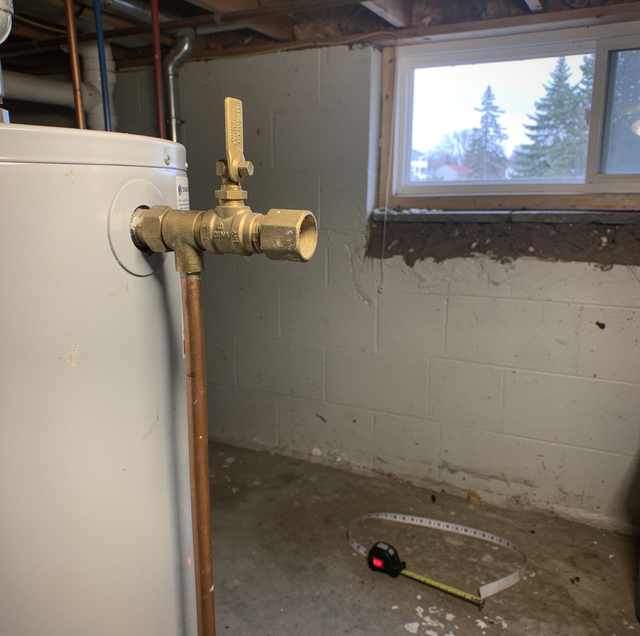
A tank or tankless heater has a shutoff on its cold inlet, and either that valve or the hot-outlet connection can choke flow without failing completely. A cold-inlet valve closed for service and reopened only partway restricts how much water enters the heater, which shows up as weak hot flow at every fixture. An older gate valve can also lose its internal wedge and stay partly shut with the handle turned fully open, which is a plumber's repair on the heater's supply.
Inside the tank, a dip tube carries incoming cold water down to the bottom, where it is heated before it rises and exits through the hot outlet near the top. When a dip tube cracks or breaks apart, its plastic fragments leave with the hot water and lodge in faucet cartridges and valve inlet screens, which is how a failed dip tube turns into weak hot flow at the taps. On top of the tank, a heat-trap fitting on the hot outlet narrows the opening by design, and debris caught inside it can choke hot flow at every tap.
A water heater's tank holds water hot enough to scald. Opening the drain valve, a heat-trap nipple, or a dip tube fitting to check for a clog risks a scald, so leave that step to a plumber.
Some homes also have a mixing valve installed just past the heater, blending tank water down to a set delivery temperature before it reaches the house. Scale or debris in its thermostatic element can narrow the hot port, and because its outlet feeds only the hot supply, a scaled mixing valve chokes the hot flow to every fixture while the cold remains untouched.
Sediment and Scale Building Up on the Hot Side
Some of the minerals dissolved in the water drop out of solution when it is heated. They collect as sediment on the tank floor, and loose flakes of that scale can be carried out with the hot water and lodge in outlet fittings and downstream screens. Cold water is never heated on its way to the tap, so the scale that heating produces forms on the hot side of the system, even in a house that draws from a shared supply.
The same process continues past the tank: hot-side piping and fixture parts can build scale that the cold side of the same fixture does not, even when both runs are the same pipe installed the same day. So a plumber checks the hot and cold sides separately rather than assuming a clean cold line means the hot line is equally clear.
Corroded Hot-Side Piping
A house of older vintage may still be running on galvanized steel supply, and that pipe corrodes internally as its zinc coating thins, so the channel water passes through keeps shrinking with age. A house running on copper or PEX instead, whether it started that way or was fully repiped since, has none of that older pipe in its walls, so this cause drops off the list there.
Galvanized corrosion narrows every run that is still steel, cold lines included, so it shows up as weak flow on the cold side too. In a galvanized house where cold still runs strong at the same tap, the search goes first to what only the hot side carries (the heater's fittings, a mixing valve, a fixture's hot port) before the pipe is blamed; weak flow on both sides at once is the pattern galvanized leaves. Whether a confirmed galvanized line should be replaced is a bigger decision than today's symptom.
Tankless Heater Flow Limits and Inlet Screens
A tankless heater doesn't store water, so it has no tank bottom for sediment to settle in, but it introduces its own hot-only restrictions. A tankless heater's cold-inlet connection can include a small mesh screen, meant to keep grit and debris out of the heat exchanger. That screen can load up with the same sediment a tank would otherwise trap, and because it sits only on that one unit's inlet, the restriction shows up strictly on the hot side while cold flow through the rest of the house stays unaffected.
A tankless unit doesn't run out of hot water the way a tank can, but it still has a maximum instantaneous flow rate it can heat to the set temperature at once. If two or three fixtures pull hot water simultaneously and together ask for more than that, some units throttle the flow to hold the set temperature and others let the temperature fall; on a throttling unit, the weak flow can feel identical to a clogged line even though nothing inside is blocked. Distinguishing a genuine restriction from the unit's own limit is part of what a plumber checks before replacing any parts.
Fixture-Level Causes on the Hot Side
When the heater and the supply line are both clear, the restriction can sit at the fixture. An aerator or showerhead screen sits after hot and cold have already mixed, so a clog there weakens both sides at once. A hot-only drop at one fixture points instead to what carries hot water alone: the hot stem or cartridge on a two-handle faucet, the hot supply stop under the sink, or debris such as dip-tube fragments lodged in the hot inlet of the valve.
A single-handle valve raises a separate possibility. Inside it, a cartridge mixes hot and cold through two narrow ports, and if scale or grit collects unevenly, the hot port can narrow while the cold port stays clear, producing weak hot water and full-strength cold from the same handle. This is different from a whole-house pressure complaint: it's isolated to one fixture and one side of one valve, and confirming that isolation is the core of the diagnosis.
Narrowing It Down Before Anything Gets Replaced
Where the weak flow shows up is the starting point, and a plumber confirms that pattern rather than guessing from it. Running the hot side at several fixtures and comparing it to the cold side at the same fixtures helps distinguish a whole-house drop from a hot-only one; if every fixture in the house runs weak on both sides, the restriction lies in the supply feeding the whole house rather than in the hot line. From there, isolating sections, checking the heater's connections first, then the supply line, then the fixture, rules out one link at a time instead of replacing a part on a guess.
That order matters because water bound for the hot side of a tap passes through parts that the cold run to the same tap bypasses: the heater's inlet valve, the dip tube, a heat-trap fitting, a tankless inlet screen, and the hot side of a fixture cartridge. Working through them in sequence, rather than starting with whichever part is easiest to see or was touched last, helps find the restriction instead of chasing the symptom around the house.
Frequently Asked Questions
Yes. A newly connected heater uses fresh fittings, and a connector nipple that got threaded in slightly cross-threaded or over-tightened during the swap can deform just enough to narrow the opening without creating a leak that would reveal the mistake. If the weak hot water started right after a replacement, the install itself is a reasonable first place to look, even when everything appears properly connected.
Yes. Some homes have had only one side of the plumbing updated over the years, for example the cold main during a remodel while the original hot branch was left in place, or the reverse. That leaves a house where the hot and cold lines are truly of different ages and materials rather than identical pipes reacting differently, so the diagnosis has to treat each side on its own merits rather than assuming they match.
It can. A leak on the hot line between the heater and a fixture bleeds off water before it reaches the tap, and a leak large enough to be felt as weaker hot flow in that branch can also show up as a rising water bill or a damp, warm spot along the run, which a clog or scale never produces.
Yes. A valve built to balance hot and cold automatically reacts to a restriction on one side by throttling the other side to match, so a shower fed by one of these valves can read as weak overall even though the restriction sits only on the hot leg. Comparing hot flow at a nearby sink, which is not fed through that valve, separates a true hot-only problem from a valve doing exactly what it's designed to do.
Yes. Where a tankless heater has isolation valves, one on the cold inlet and one on the hot outlet, each with a small purge port used when the heat exchanger is flushed, a hot-side valve left partly closed after that service restricts hot flow to the whole house while the unit itself tests clean.
Yes. On a compression faucet, the hot stem carries a rubber washer, and one that has swelled, split, or come loose can partly block the hot port; a cartridge faucet takes a replacement hot-side cartridge matched to that faucet. Either repair restores hot flow without replacing the whole fixture.
Bring in a plumber for a hot-only pressure drop — the heater's valves and fittings, the hot supply, and the fixture are checked one link at a time until the restriction is found. AT Plumbing Services serves Scarborough, South Portland, Portland, and surrounding areas. Call (207) 707-3170.