
Sewer Camera Inspection on Cast Iron: What It Can't Tell You
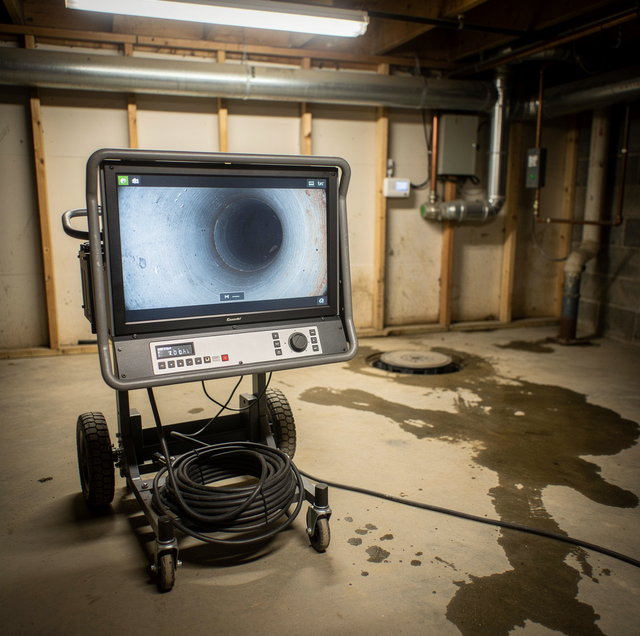
The technician has already fed the cable in, and the monitor is showing gray iron pipe scrolling past at walking pace. It's tempting to wait for someone to simply say whether the news is good or bad. A camera run down a cast iron drain answers real questions, but it isn't one tidy verdict, and it's answering a different question than the same equipment would answer inside a length of PVC or clay. Cast iron fails in its own particular way, from the inside out and from the bottom up, and reading that failure off a screen takes more interpretation than most homeowners, or the plumbers explaining it to them, tend to let on.
Reading a Cast Iron Line From the Inside
Several distinct defects show up on the screen inside an old cast iron line, and a technician is trained to recognize each one before the run is even finished. The first is channeling: the invert, the very bottom of the pipe, corrodes away years faster than the rest of the circumference because that's where waste and standing moisture sit the longest. The crown, the top arc, can still look nearly new while the bottom has worn into an open trough, so the pipe stops being a round tube and becomes something closer to a gutter with a lid on it. The second is tuberculation: a hard, knobby buildup in which corrosion products and mineral scale cement themselves to the wall, narrowing the usable bore and giving debris something rough to catch on as it passes. The third is a belly, a section that has settled or sagged just enough that the pipe no longer holds a steady downhill grade, so water pools in the low spot between uses instead of clearing. The fourth is root intrusion at a joint, where a hairline gap between two sections of pipe gives roots a way in, and once a root mass takes hold, it both blocks the line and widens the joint.
The First Few Feet Aren't the Whole Line
A homeowner who watches the first few feet of a camera run often relaxes too soon. The section right at the cleanout, or where the line leaves the house, tends to be short, close to a vertical stack, and less exposed to standing water than a long horizontal run underneath a slab or crawlspace. Corrosion needs standing moisture and time to do its work, so a section that drains fast and dries between uses can look almost new decades after installation, while thirty feet further along, where the same line settles into a flatter run and holds water between flushes, the invert has been quietly wasting away the entire time. A technician runs the camera the full length of the line specifically because the condition changes section to section, sometimes sharply, and a clean picture at the access point is not evidence about what the middle of the run looks like.
What the Picture Cannot Prove
A sewer camera is a useful eye, but it's still just a lens on a cable, and there are questions it cannot answer no matter how sharp the picture looks.
Remaining wall thickness: The camera shows the inside surface, the bore. It has no way to measure how much solid iron remains on that surface. A wall that has lost half its original thickness to slow corrosion can still present a smooth, intact-looking inner surface right up until it doesn't.
Whether the soil around a break has washed out: A crack or a small hole in the pipe wall can let fine soil migrate into the line over years, leaving a void outside the pipe that the camera, looking only at the inside, has no way to show. That void often matters more than the crack itself, because it's what eventually leads to a settled section of yard or a pipe with nothing left underneath to support it.
How much of what's on screen is scale versus lost metal: Tuberculation and old corrosion products can build up thick enough to look like they're narrowing a pipe that has actually lost real wall material underneath the buildup, or the reverse: a channel that reads as shallow because scale has partly filled it back in, hiding how much of the original wall is actually gone.
None of this makes the inspection a wasted step. It means a clean-looking pass is not proof of a sound pipe. It only means nothing large enough to fill the lens's view showed up in that particular pass, on that particular day.
The Locator and the Depth Reading Matter as Much as the Video
The picture on the monitor is only half the tool. As the camera head moves along the line, a transmitter inside it sends a signal that a technician above ground tracks with a separate locator, marking the pipe's path and the depth at each point. That pairing is what turns a defect on screen into a place a shovel can find. Without it, a technician can describe a channel or a belly by its distance down the cable from the cleanout, which tells a crew roughly how far in to dig but nothing about where across the yard or how deep, and old cast iron rarely runs in a perfectly straight line from the access point to the street. The depth reading also flags a section that sits shallower or deeper than the rest of the run, which is itself a clue: a stretch that has settled lower than its neighbors is very often the belly the footage just showed holding water.
When the report comes back, ask for the depth and a surface mark at each defect, not only its distance from the cleanout. Distance alone tells a crew how far in to dig, not where across the yard.
Why the Line Often Needs Cleaning Before the Camera Can See It
A camera cannot see through scale, sludge, or a mat of grease and debris. Before most old cast iron lines get a useful inspection, they get cleaned first, usually with a jetter or a cable machine that cuts back the buildup coating the walls so the lens has something to actually look at instead of a tunnel of gunk. On a line that has been narrowing for decades, this step alone often restores flow a homeowner had written off as normal for an old house.
It's also the point in the process with the most honest risk attached to it. A pipe that has been thinning from the inside for fifty or sixty years can be structurally dependent on the scale and tuberculation lining its walls; that buildup, ugly as it looks on camera, is sometimes doing real work holding a wafer-thin section together. Cutting it away with a jetter or an aggressive cable head can open a hole in a wall that scale alone was bridging. A careful technician reads the pipe's overall condition as the cleaning proceeds and eases off on a run that already looks marginal, rather than force a clear picture at the cost of causing the failure the inspection was meant to catch early.
Turning the Footage Into a Repair Decision
Once the line has been cleaned and the run recorded and located, the footage becomes the basis for an actual repair decision, not just a diagnosis in the abstract. A spot repair, cutting out and replacing a short section of pipe, makes sense when the damage is localized: one bad joint, one length of channeled pipe in an otherwise sound run, an isolated crack. It's the least invasive option because it only touches what's actually failed.
Lining, pulling a resin-saturated liner through the existing pipe and curing it in place to form a new pipe inside the old one, fits a line that has degraded fairly evenly along its length rather than in one obvious spot: scale and corrosion without a hole all the way through, and without a belly severe enough to trap the liner material before it cures.
Full replacement is the answer once the damage stops being a set of isolated defects and starts being the general condition of the pipe: a belly the liner can't bridge, multiple sections that have channeled through, a joint that's separated rather than just cracked, or a run where root intrusion has recurred at more than one point. At that stage, patching or lining is buying a few more years on a pipe that has already used up its structural margin, and the footage tells a technician which of these three situations is actually sitting in the ground, rather than guessing from the symptoms upstairs.
Frequently Asked Questions
On a buried run, no. Where a length of the line is exposed in a basement or crawlspace, a technician often supplements the video with a simple sounding test: tapping along the pipe with a hammer handle and listening to the tone it produces. Sound iron rings. Iron thinned to a shell answers with a dull thud instead, and the point where the tone changes marks roughly where the good pipe ends.
Less time than the previous cleaning. On a straight run with good access, the camera goes in and comes back out in a single continuous pass. A system with several offsets, a house trap, or multiple branch lines takes considerably longer, because the technician has to stop and reorient the picture at every joint and turn rather than pulling the cable straight through.
Not in one pass, and often it shouldn't be. On a heavily coated line, a technician typically makes a first, conservative cut with a smaller cable machine, runs the camera to assess how much wall remains, and only then decides whether it is safe to bring out heavier jetting equipment. Sequencing it that way keeps the aggressive tool off a section that turns out to be marginal.
Depth readings are reliable enough to point a crew to roughly the right spot to open the ground, but disturbed soil, fill dirt, or a nearby buried utility can skew the signal. That's why a crew typically hand-digs the last stretch to expose the pipe rather than bringing heavy equipment down to the marked depth directly.
A cured-in-place liner does take up a small amount of the pipe's interior diameter, generally a fraction of an inch. On a line that scale and tuberculation had already narrowed well below its original bore, the finished liner is often a smoother, more open path than the corroded original was carrying water through the day before the work started.
It has become a common step in transactions involving older housing stock. Buyers, their inspectors, and increasingly insurers writing policies on older homes ask about the condition of original drain lines, and a recent camera inspection with a clear record of its findings is often the fastest way to answer that question rather than leaving it open at closing.
Get a second, plain-English read on your cast iron camera footage — a clear call on spot repair, lining, or replacement, not just a video file. AT Plumbing Services serves Scarborough, South Portland, Portland, and surrounding areas. Call (207) 707-3170.
