
Tankless Heater Recirculation Pump: Do You Actually Need One?
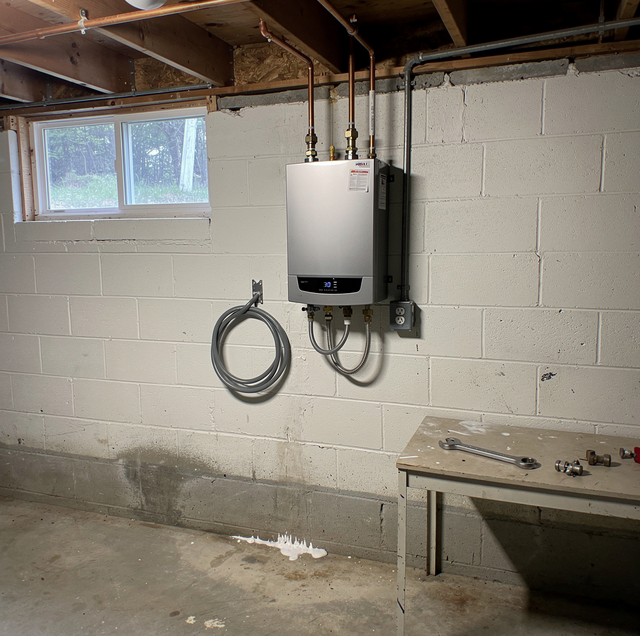
"Endless hot water" is the phrase everybody remembers about going tankless, but it's often heard as "instant hot water." Those are two different claims, and only one of them is being made. A tankless unit removes the limit on how *much* hot water you can draw. It does nothing about how *far* that water has to travel.
The wait at a distant fixture is a geometry problem, not a heater problem. Every foot of pipe between the unit and the tap is already full of water that has been shedding heat into the pipe wall since anyone last used that fixture. Open the tap and that cooled water leaves first. The burner fires as soon as flow starts, but the water it heats is at the back of the line.
Quick Answer: Not always. A tankless unit fixes how much hot water you get, never how long it takes to arrive. Recirculation is what shortens the wait, and which version fits depends on the distance and the pipe already in the walls.
Recirculation is the family of answers to that problem. Everything below assumes the tankless unit has already been chosen or is already on the wall. The conversion decision, venting, and gas sizing are a different subject; what follows deals only with the wait for hot water at the tap.
No Recirculation at All
The mechanism: nothing moves the standing water until you open a tap and push it out. The wait is the volume held in the run divided by the fixture's flow rate, so pipe diameter matters as much as length. Cold incoming water lengthens it further, since the unit has more temperature rise to deliver before the leading edge reads hot, an effect that peaks in the coldest months in cold-climate homes, though the standing-water wait exists year-round.
When this is the right answer: a compact house, a unit mounted near the bathrooms that matter, short branch runs, and a household that has never complained. No pump means no controls to fail, no circulator to replace, and no heat lost from a warm loop. The trade is water down the drain while you wait, and if that is not a live complaint, added hardware buys little.
A Dedicated Return Line
The mechanism: a second hot-water pipe runs from the far end of the hot main back to the heater, closing a loop. A circulating pump moves water around it so the main holds warm water rather than room-temperature water when someone opens a tap. A check valve keeps flow going one direction only, so cold supply pressure cannot shove water backward through the return when the pump is off.
This version performs best, because the cold line stays cold and the loop does exactly one job. It also depends most on what already exists behind your walls: running a return through an open basement ceiling or during a gut remodel is ordinary work, while running one through a finished, occupied house means opening and repairing surfaces.
What it trades away: a loop kept warm loses heat continuously into the framing around it, and that heat has to be replaced. It also adds a pump and its controls to the list of things that can fail.
A Crossover Valve at the Farthest Fixture
The mechanism: no new pipe at all. A thermostatic crossover valve, sometimes sold as a comfort valve, is installed under the farthest fixture and bridges the hot and cold supplies there. While the water on the hot side is cool, the valve stays open, pushing cooled water out of the hot line, across the bridge, into the cold line, and back toward the heater's cold inlet. When hot water arrives, the thermostatic element expands and closes the crossover, isolating the two lines again.
That makes the cold line the return path, which is why this works in a finished house with no room for new pipe. It is also one of its real drawbacks: the cold line near that fixture now carries warm water, so a cold tap can run tepid before it clears.
A crossover valve puts hot water into the cold line at that fixture, so a tap set to cold can briefly run hot. Raising a heater's setpoint to compensate for a long wait is a scald hazard and licensed-plumber work.
What it trades away: temperature separation between the two lines at that fixture, and some performance against a true dedicated return, since it borrows a pipe rather than using one built for the job.
On-Demand, Timer, or Continuous Operation
Both loop types still need a decision about *when* the pump runs. That control layer is where most of the energy-versus-wait trade lives.
Continuous operation: the pump runs whenever the system has power. The wait is shortest, at any hour, with nobody doing anything. It also keeps the loop warm around the clock and asks the burner to replace that lost heat continuously, including all night while nobody is home.
A timer: the pump runs only inside windows you set, typically the parts of the day the household uses hot water. Outside that window you get the no-recirculation wait, which surprises people who forget the schedule.
An aquastat: a temperature sensor starts the pump when loop temperature falls past a set point and stops it once the loop recovers, so the pump runs in short bursts driven by heat loss rather than by the clock. It is often paired with a timer rather than used instead of one.
An on-demand button or motion trigger: the pump runs only when someone presses a button near the fixture or walks past a sensor. Standby loss is lowest because the loop sits at room temperature most of its life. The trade is that you still wait, just for the pump's fast circulation rather than a fixture's slow trickle.
What Tankless Adds to the Problem
Everything above applies to any water heater. Four things are specific to tankless, and they are why a pump cannot simply be bolted on.
Minimum activation flow: a tankless burner does not fire until water flows through the unit faster than a threshold set by the manufacturer. A loop that circulates gently may sit underneath it, so the pump runs and the loop never gets heated. That threshold is a published figure on the unit's specification sheet, not a universal number, which is why pumps and tankless units are chosen as a matched pair.
Compatibility is published per pump-and-unit pairing, not inferred from flow ratings alone, and some tankless models already include an internal pump that satisfies the requirement on their own. Bring the unit's spec sheet to the quote, not the pump's.
The cold-water sandwich: when one draw stops and another starts soon after, water still sitting hot inside the heat exchanger comes out first, then the slug that sat in the pipe long enough to cool, then newly heated water. Hot, then cool, then hot, is what people mean when a tankless unit "surges." Recirculation reduces how cool that middle slug gets, since the pipe never goes fully cold.
A built-in buffer tank or internal pump: some models include a small internal buffer tank, an internal recirculation pump, or both, with control logic tailored to the unit's burner and flow sensor. If yours has one, part of the answer is already on the wall. What it is designed to drive comes from that model's specification, not from a general rule.
Scale on the exchanger: a loop sends the same water back through the heat exchanger repeatedly instead of once, and in water carrying dissolved minerals, that repeated exposure gives scale more chances to deposit on the surface and restrict flow. The countermeasure is periodic flushing through the isolation valves at the unit, at intervals the manufacturer sets, and that is licensed-plumber work that belongs in the decision rather than arriving later as a surprise.
What Actually Decides It in a Given House
Distance and the plumbing you already own. Everything else hangs off those two.
Pin down the real complaint first: which fixture is the problem, the shower people care about or a rarely used powder room. Then find out whether a return path exists. An open basement ceiling, an accessible chase, or a remodel in progress makes a dedicated return reasonable; a finished house with no path makes a crossover valve the practical option. Where the unit already sits near the fixtures that matter, the right recommendation is often no pump at all.
| Configuration | What it needs | What it trades away |
|---|---|---|
| No recirculation | Nothing beyond the existing hot line | Wait time at distant fixtures, water run to drain |
| Dedicated return line | A second pipe from the far end back to the unit, a pump, a check valve | Access to run the pipe, continuous loop heat loss, added equipment |
| Crossover valve | A thermostatic valve under the farthest fixture, a compatible pump | Warm water in the cold line at that fixture, some performance |
| Control mode on either loop | Continuous power, a schedule, an aquastat, or a trigger at the fixture | Standby loss rises as the wait falls, and the reverse |
The right configuration matches the house, the unit's specification, and the fixture that actually annoys you. That assessment belongs on site.
Frequently Asked Questions
No. A heating-loop circulator typically has a cast-iron body, correct for a sealed hydronic loop where the same de-oxygenated water circulates for years. Domestic hot water is oxygenated and constantly refreshed, so it corrodes cast iron, and a heating circulator's wetted parts aren't rated for drinking water. A domestic pump uses a lead-free bronze or stainless-steel body instead.
A tank-type heater usually has a dedicated return port on the tank itself, providing the loop with an obvious landing point. A tankless unit has no tank and no such port, so the return normally ties into the cold supply piping ahead of the unit's inlet. Exactly where that tie-in lands is part of what the installer works out.
Considerably. A home-run system feeds each fixture from a central manifold through its own small-diameter line rather than shared trunks and branches, so each line holds less standing water and the wait at many fixtures is already short. A loop there has to serve the manifold rather than the individual runs, which changes both the design and the benefit.
Sometimes, when exactly one remote fixture is the complaint. A point-of-use electric heater under that sink holds hot water at the fixture, on its own dedicated electrical circuit, and removes the travel distance for that outlet. It will not meet the demand of a shower and adds a second appliance to maintain, so it suits a remote hand sink better than a bathroom group.
It helps, and it is one of the simplest improvements available. A closed-cell foam sleeve or fiberglass wrap on the hot line slows how fast standing water sheds heat, so it stays usable longer between draws. On a recirculating system, the return leg should be insulated too, since an uninsulated return is a heat leak the burner pays for every cycle. Insulation improves a wait without removing it.
It is a good moment to review thermal expansion. Where a pressure-reducing valve or a backflow preventer makes the supply a closed system, heated water has nowhere to expand into, and a properly sized potable expansion tank absorbs that volume change. Adding a pump and a loop is the moment to confirm that piece is present and working.
Have your hot-water wait diagnosed at the fixture itself before any pump is chosen — the right configuration depends on your plumbing and your unit's specifications, not on a catalog. AT Plumbing Services serves Scarborough, South Portland, Portland, and surrounding areas. Call (207) 707-3170.
